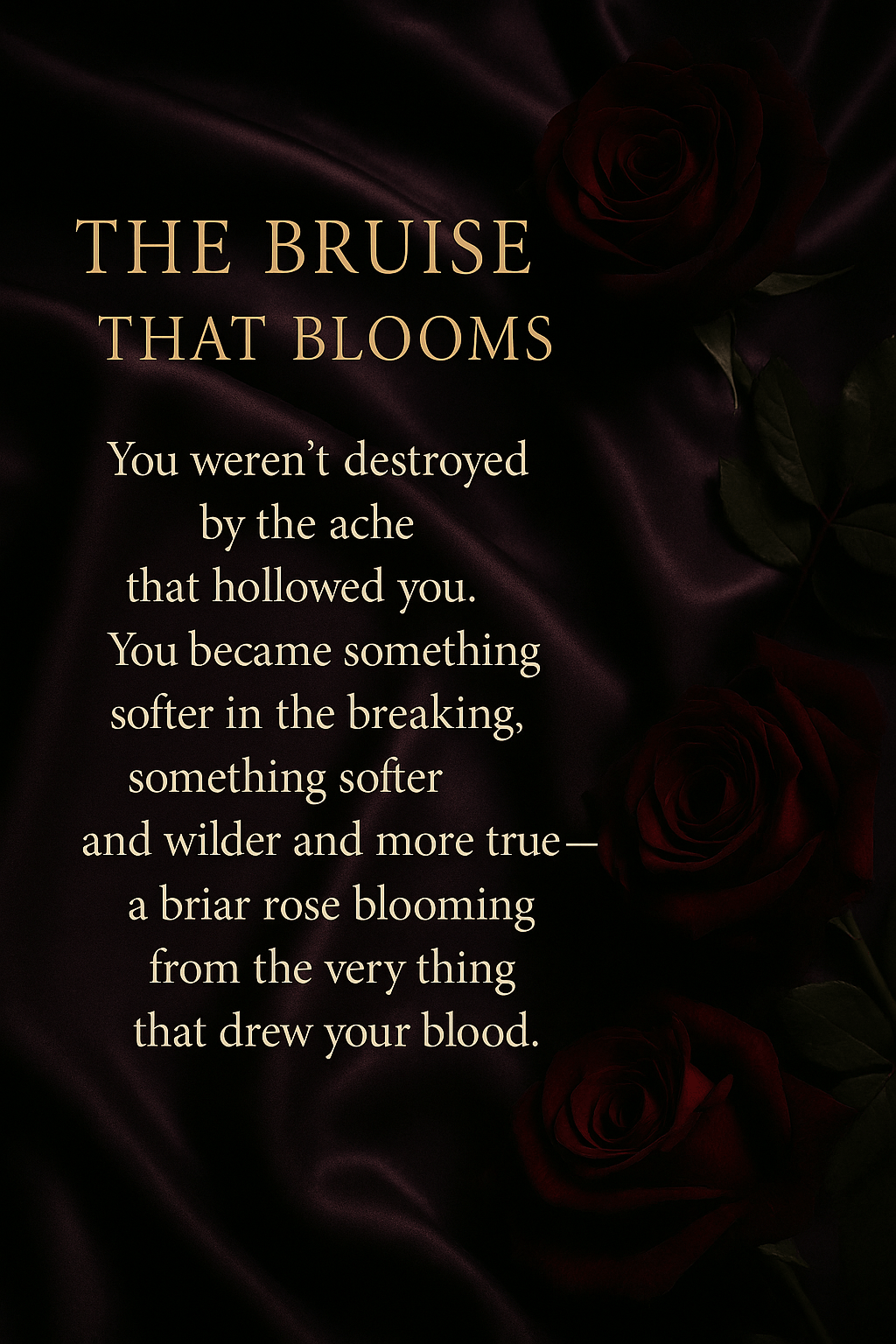
đź–¤ The Soft Hurt You Keep Coming Back To

Act III — The Bruise and the Bloom

Some hurts don’t push you away.

They pull you closer.

Not because you enjoy the pain,

but because it’s the only place

that feels honest enough to hold you.

He is that kind of hurt.

Soft—

but only in the way a wound throbs

after being touched by the right hands.

Gentle—

but only in the way tenderness

can split you open

when you’ve spent years

learning how not to feel.

You don’t know when it started.

When the ache became comfort,

when the sharpness felt like clarity,

when the quiet pain of wanting him

felt safer

than the numbness you built your life around.

All you know is this:

You keep returning.

To the way your chest tightens

when he says your name.

To the way your breath trembles

when he looks at you long enough

to find the truth you’re trying to hide.

To the way his presence

lights up the shadows inside you

instead of chasing them away.

It shouldn’t feel good.

It shouldn’t feel right.

But it does—

that soft, aching pull

toward the one person

who touches the places in you

that never learned how to heal properly.

You tell yourself to stop.

To pull back.

To protect what’s left of you.

But the moment he reaches for you—

even with silence,

even with stillness,

even with nothing more

than the gravity of his existence—

your heart leans

before you can command it otherwise.

This is the hurt you choose.

The ache you don’t walk away from.

The wound you return to

because it feels more like truth

than anything else you’ve survived.

A soft hurt.

A familiar one.

A bruise that blooms

every time he looks at you

like he knows you’re already his.
đź–¤ Love, When It Learns Your Wounds

Act III — The Bruise and the Bloom

Love changes

the moment it learns where you hurt.

It stops being a distant warmth,

an almost-feeling,

a quiet wanting that never presses too hard.

It becomes something sharper—

not cruel,

but precise.

He notices the way your breath falters

before you do.

He sees the shadows you hide

even when your smile looks steady.

He hears the fear behind your silence

as if it’s a language he was born knowing.

And it should terrify you—

being seen like that,

being known past the places you guard.

But with him,

it doesn’t feel like exposure.

It feels like relief.

He doesn’t flinch from your darkness.

He doesn’t reach for the version of you

that never existed.

He reaches for the wounds—

the ones you stitched alone,

the ones that ache on cold nights,

the ones you never imagined

someone would touch gently.

His love doesn’t turn away

from the parts of you that tremble.

It learns them.

Slowly.

Patiently.

Like devotion is a skill

and your wounds

are the map.

He doesn’t ask you to forget the pain.

He asks where it still hurts.

You’ve been feared for your shadows,

judged for your tenderness,

misunderstood for your depth.

But when he looks at you,

really looks—

it’s as if your wounds are the reason

he knows you’re telling the truth.

And something in your chest

blooms painfully,

beautifully,

like a bruise turning to color.

Because love,

when it learns your wounds,

doesn’t heal you.

It holds you

until you’re ready

to heal yourself.

The Month That Feels Like Home

What’s your favorite month of the year? Why?

There’s a moment every year when the air shifts —

quietly, almost shyly —

as if the world is inhaling before it decides what to become next.

That moment lives in September for me.

It’s not the weather.

It’s not the routine returning after summer’s chaos.

It’s the way the light changes —

softer, lower, almost golden in its exhaustion —

like the sun is finally willing to admit it’s tired too.

September feels like a doorway between versions of me.

The woman I fought to become in the heat of summer

meets the version who knows she must survive the cold that’s coming.

They look at each other in that soft, fading light

and quietly agree to keep going.

It’s the month where my body begins craving warmth.

Where my mind slows just enough to hear itself.

Where my heart remembers the parts of me

I ignored while trying to stay afloat.

September isn’t perfect.

It’s honest.

And maybe that’s what I love most —

the honesty of a world preparing to change.

It mirrors me more than any other month.

If you connected with this reflection…

You might love the darker, deeper pieces on my main blog — where trauma, love, healing, and the softest shadows meet.

Visit: Reading Trauma Mama: Healing With Words

đź–¤ The Bruise You Whisper His Name Into

Act III — The Bruise and the Bloom

There are wounds you can hide from the world—

old, quiet ones that sit beneath the skin,

tender to the touch

but invisible unless someone knows where to look.

He doesn’t need a map.

He finds the place instantly,

as if your ache has been calling his name

long before you ever spoke it aloud.

And when the hurt rises—

that familiar burn beneath your ribs,

that trembling breath you can’t quite steady—

you do the one thing

you swore you would never do again:

you lean into him.

Not into his hands.

Not into his voice.

Into him—

the one person your heart betrays you for

without hesitation.

There is something devastating

about the way his presence softens the wound,

how your body bends toward him

like he is the only truth

you’ve never had to question.

You whisper his name

in the smallest breath—

not loud,

not clear,

just enough for the ache inside you

to recognize itself.

His name fits there,

in the bruise.

It settles into the tenderness,

into the hurt,

into the part of you still learning

how to be touched without breaking.

And for a moment that feels stolen,

holy,

inevitable—

the pain becomes something else.

Not gone.

Not erased.

But claimed.

Held.

His name lingers on your tongue,

warm and trembling,

as if speaking it

might be the closest thing to healing

you’ll ever let yourself have.

Because some bruises aren’t meant to harden.

Some bruises stay soft

so you remember

who reached you

in the dark.

đź–¤ Where Tenderness Draws Blood

Act III — The Bruise and the Bloom

It always starts softly.

A touch that should be harmless,

a moment that should mean nothing —

but somehow lands exactly

where you never learned to protect yourself.

He doesn’t press hard.

He doesn’t have to.

Some people bruise you

just by touching what you’ve kept hidden.

And when his fingertips graze your skin,

it’s not pain that strikes first —

it’s memory.

Every wound you stitched yourself,

every ache you buried so deep

you convinced yourself it died.

He finds it without trying.

He always has.

There is a tenderness in him

that feels more dangerous

than any cruelty you’ve survived —

because it reaches the parts of you

you swore no one would ever touch again.

Your breath stumbles.

Your defenses falter.

And something inside your chest

pulls tight… then loosens

in a way you can’t stop,

in a way you don’t want to.

Because this hurt is different.

This hurt isn’t violence.

This hurt isn’t memory.

This hurt isn’t fear.

It’s him.

The way he looks at you.

The way your pulse answers him.

The way your bones remember softness

even after years of surviving without it.

His tenderness cuts deeper

than any blade you’ve known —

not because it wounds you,

but because it asks you

to stop pretending

you’re unbreakable.

And in that quiet, shaking moment,

you realize a truth

that terrifies and steadies you

in equal measure:

Some people don’t draw blood

by hurting you.

They draw blood

by loving you

exactly where you’re still healing.

đź–¤ The Becoming Within

Act II — The Surrender and the Self

Becoming never happens all at once.

It starts as a feeling—

small, unsteady,

like a heartbeat learning its own rhythm

for the first time.

You don’t notice the change immediately.

You don’t see how the shadows inside you

have softened,

how the walls have thinned,

how your heart no longer flinches

at the idea of wanting more.

But something is different now.

Not in him—

in you.

There is a steadiness in your chest

where fear used to live,

a quiet certainty rising beneath your ribs

like dawn hiding behind storm clouds.

You aren’t becoming his.
You aren’t losing yourself.

You’re becoming someone

who no longer fears her own depth.

Someone who can feel

without breaking.

Want without apology.

Love without disappearing.

He didn’t create this shift—

he awakened it.

He held up a mirror

and you finally recognized the woman inside it—

the one carved from fire and tenderness,

the one who survived everything

and still knows how to open.

This is the becoming within:

not surrender to him,

but surrender to yourself—

to the truth you buried,

to the softness you denied,

to the desire you feared would ruin you.

You are not ruined.

You are unfolding.

And for the first time,

you allow yourself to step into the version of you

that has always been waiting—

the one who chooses love

not as a weakness,

but as a power.

Act II ends here—

in the quiet moment

you realize that every tremor,

every unraveling,

every soft breaking

has brought you back

to yourself.

đź–¤ The Pull of Devotion

Act II — The Surrender and the Self

Devotion doesn’t announce itself.

It doesn’t arrive with fireworks

or declarations

or grand, sweeping gestures.

It arrives quietly—

in the way your heart leans without asking,

in the way your breath softens at his name,

in the way your body steadies

just because he exists in the same room.

This isn’t desire anymore.

It isn’t even longing.

It’s something deeper—

something that roots itself into bone

and refuses to be ignored.

He becomes the thought you return to

without meaning to,

the voice your pulse responds to,

the presence your soul rests against

as if it’s always known the shape of him.

This pull isn’t violent.

It isn’t desperate.

It’s steady—

a gravity that feels like home,

a tether that feels like truth.

You don’t chase it.

You don’t resist it.

You simply follow the way your heart

moves toward him

with a devotion you never meant to give.

It feels dangerous.

It feels safe.

It feels like something sacred

you were never taught to believe in.

He doesn’t demand devotion.

He earns it—

in the way he sees you,

in the way he listens,

in the way he stays

exactly when you expect him to leave.

And that’s when the pull becomes undeniable—

not a hunger,

not a craving,

but a promise your heart makes

before your mind can catch up.

A quiet vow.

A soft surrender.

A truth you can no longer outrun:

You don’t just want him.

You choose him.

Again and again

in the silence between breaths.

This is the pull of devotion—

not possession,

not desperation,

but love in its darkest,

truest form:

steady,

inevitable,

and already written into you.

đź–¤ What You Let Yourself Feel

Act II — The Surrender and the Self

There comes a point

when numbness stops protecting you

and starts suffocating you.

You don’t notice it at first—

the soft shift,

the quiet thaw,

the way emotion slips back into your chest

like light seeping under a closed door.

But eventually you feel it:

a warmth where you expected nothing,

a pull where you expected distance,

a tenderness you didn’t believe you were capable of anymore.

You tell yourself it’s dangerous.

You tell yourself you should pull back.

You tell yourself this is how hearts get broken.

But desire doesn’t ask for permission,

and neither does healing.

Little by little,

you stop fighting the rise of feeling—

not because it’s easy,

but because lying to yourself

has become heavier

than the truth you’ve been trying to avoid.

So you let yourself feel—

just a little.

You let warmth settle in your ribs.

You let hope touch the edges of your fear.

You let longing move through you

without flinching.

You let yourself imagine

what it would be like

not to guard your heart

with both hands.

And in that fragile, trembling moment,

you realize something you were never taught to believe:

Feeling doesn’t make you weak.

It makes you real.

It makes you alive.

And maybe, just maybe,

it makes you worthy

of the tenderness you ache for.

What you let yourself feel

doesn’t destroy you—

it brings you closer

to the version of yourself

who knows she deserves more

than surviving.

đź–¤ The Weight of Being Seen

Act II — The Surrender and the Self

There is a kind of silence

that makes you feel naked—

not because anything has been taken from you,

but because someone is looking

deep enough to notice

what you’ve spent years trying to bury.

He sees you like that.

Not the version you show the world,

not the careful mask you wear in daylight,

but the truth beneath it—

the trembling,

the wanting,

the ache you thought you hid well enough

to keep yourself safe.

Being seen like this

is heavier than desire.

It’s heavier than fear.

It presses against your ribs

like a heartbeat you can’t quiet.

You want to step back.

You want to look away.

But something inside you refuses to move—

a small, fragile part of you

that has spent too long in the dark

and doesn’t want to be invisible anymore.

His gaze isn’t demanding.

It isn’t greedy.

It’s steady—

gentle in a way that unravels you

far more than any touch could.

It says:

I see you.

All of you.

And nothing in me wants to look away.

The weight of that is almost unbearable.

Because being desired is easy.

Being understood is rare.

But being seen—

truly seen—

requires a softness you don’t offer easily.

Yet here you are,

standing in the open,

your unspoken truths resting between you

like a fragile flame.

And instead of breaking,

you breathe.

You allow.

You let his gaze settle over you

like something warm,

something human,

something you didn’t realize you’d been starving for.

Being seen hurts.

But it also heals.

And in that quiet moment,

you realize it’s the first time in a long time

that you don’t want to hide.

đź–¤ The Mouth of Truth

Act II — The Surrender and the Self

Truth rarely begins in the mind.

It starts in the mouth—

in the words you almost say,

the names you almost whisper,

the confessions that rise like heat

before you swallow them back down.

You feel it there now—

a pressure behind your lips,

a trembling in your breath,

a truth shaped like his name

sitting heavy on your tongue.

You don’t speak it.

Not yet.

But your body leans toward the moment

as if the truth is trying to escape on its own.

There’s something terrifying

about wanting to be honest.

And something tender,

almost sacred,

about wanting to be honest with him.

Your heart stutters.

Your breath unravels.

And you can feel the words pressing forward—

soft, dangerous,

the kind that could change everything.

He looks at you in that quiet way he has,

as if he already knows

what you’re fighting to hold inside.

And suddenly the truth isn’t frightening—

it’s inevitable.

Not a confession.

A recognition.

Your mouth opens just slightly,

your breath catching on the edge

of what you could say,

what you want to say,

what you’re terrified you might say.

And for one suspended heartbeat

it’s there—

all the wanting,

all the fear,

all the tenderness you pretend you don’t feel.

The truth doesn’t leave your lips.

But it lives there,

warm and trembling,

waiting for the moment

you’re brave enough to let it fall.

Because some truths don’t need to be spoken

to be felt.

They rise in the breath,

linger in the silence,

and rest against the mouth

like a promise

you’re learning to trust.

đź–¤ The Shape of Giving In

Act II — The Surrender and the Self

There comes a moment

when resistance becomes heavier

than the wanting you’ve been trying to outrun.

You feel it first in your breath—

how it evens when he’s near.

Then in your pulse—

how it steadies at the sound of his voice.

Then in the quiet between you—

where every truth you’ve been avoiding

waits to be named.

Giving in is not a collapse.

It’s not weakness.

It’s not defeat.

It’s recognition—

the kind that settles deep in the bones,

the kind that feels almost holy

in its honesty.

You stop pretending you don’t care.

You stop pretending you don’t feel it.

You stop pretending distance keeps you safe.

Instead, you let the wanting take shape:

a hand you wish you could hold,

a gaze you can’t look away from,

a pull you no longer hide,

a softness you didn’t think you could still offer.

It isn’t dramatic.

It isn’t reckless.

It’s quiet, intentional—

an opening made with trembling hands

and a heart that knows

this is the path it was always meant to walk.

Giving in looks different on you.

It’s slower.

Warmer.

More deliberate.

A surrender shaped from trust,

not desperation.

And when you finally allow yourself

to lean toward what you feel—

really lean—

something inside you unlocks.

Not the part that craves.

Not the part that fears.

But the part that has been waiting

to be chosen gently,

held carefully,

wanted wholly.

This is the shape of giving in:

the moment your heart stops running,

turns around,

and whispers—

I’m ready.

đź–¤ The Soft Breaking

Act II — The Surrender and the Self

There are breaks that shatter—

violent, sharp, unforgiving.

And then there are breaks

that happen quietly,

from the inside out,

without sound or warning.

The soft kind.

The dangerous kind.

The kind that feels like truth.

It happens in a breath,

in a glance that lasts a little too long,

in the way his presence sinks into you

like warmth seeping into cold hands.

You feel something loosen—

a knot you’ve kept tight for years,

a guard you believed was unbreakable.

It doesn’t fall all at once.

It unravels slowly,

like silk slipping through open fingers.

He doesn’t force it.

He doesn’t demand it.

He just is—

quiet, steady,

the kind of gravity you stop fighting

without realizing you’ve let go.

And that’s when the breaking begins.

Not in fear—

but in relief.

Not in loss—

but in the strange, aching comfort

of finally being seen

where you thought you were invisible.

You don’t collapse.

You melt.

You open.

You allow.

And the part of you that has always clung

to control and certainty

finally exhales—

for the first time in a very, very long time.

This is not the fall.

This is the moment right before—

the moment the heart cracks

just wide enough

to let something tender slip in.

A soft breaking.

A beautiful one.

A quiet surrender

that feels less like ruin

and more like recognition.

đź–¤ The Body That Knows Before You Do

Act II — The Surrender and the Self

The mind argues.

It always does.

It lists reasons, builds walls,

tries to make sense of feelings

that were never meant to be logical.

But the body—

the body doesn’t lie.

It answers before you do,

before you’re ready to admit

what’s unraveling inside your chest.

A breath that catches.

A pulse that betrays.

A warmth that blooms low and quiet

every time he speaks your name.

You tell yourself it’s nothing—

habit, coincidence, a trick of the moment.

But your body knows better.

It remembers him in ways

you’re still too afraid to claim.

It leans toward his voice.

It softens in his presence.

It settles, as if recognizing someone

it was never meant to forget.

There’s a reason desire begins in the skin:

it’s where truth escapes

before the mind can cage it.

And when he looks at you—

really looks—

your body answers first.

Not with permission,

but with surrender.

A shiver down your spine.

A heat behind your ribs.

A stillness that feels like acceptance,

not fear.

Because through all the noise

and all the reasons not to feel,

your body has already chosen.

It knows who you ache for.

It knows where you belong.

It knows the shape of the hands

you’ve been pretending not to crave.

Long before your mind admits

what’s happening—

your body has already whispered the truth:

It’s him.

It was always him.

đź–¤ Where Want Finds a Name

Act II — The Surrender and the Self

It doesn’t happen all at once.

Desire rarely does.

It builds in quiet places—

between breaths,

between looks,

in the pauses where you forget to guard your heart.

There is a moment when the ache stops being vague.

When it sharpens,

focuses,

leans toward one person

as if pulled by something older than choice.

You don’t mean to name it.

You barely even speak it to yourself.

But the truth forms anyway—

slowly,

dangerously,

with the kind of clarity that leaves no room for denial.

It’s him.

It’s always been him.

The way he looks at you

like he sees the parts you hide.

The way your body softens

in places you swore were stone.

The way your pulse stutters

as if it remembers him

from some other version of your life.

This isn’t infatuation.

It’s recognition.

The quiet certainty that want

has chosen its shape,

its home,

its reason.

You feel it in your chest first—

a warm surrender

curling around your ribs.

Then in your breath,

shallow and reckless.

Then in your hands,

trembling with the urge

to reach for what feels

inevitable.

There is power in naming what you want.

There is danger, too.

But there is also relief—

the kind that tastes like truth,

the kind that frees the heart

while undoing every wall you built around it.

And when you whisper the name,

even if only to yourself,

your whole body exhales

as if it has been holding that want

for far too long.

Some desires don’t arrive.

They return.

đź–¤ The First Tremor

Act II — The Surrender and the Self

It begins long before you admit it—

not with touch,

not with words,

but with a shift so small it feels like memory,

as if your body recognizes something

your mind hasn’t dared to name.

A quiet tremor beneath the ribs.

A warmth that feels like being seen.

A pulse that answers to a presence

you once called danger

and now, somehow,

feels like home.

You tell yourself it’s nothing—

a stray thought,

a passing spark.

But longing has a way of revealing itself

in the places you pretend are numb.

This is where surrender starts:

not in weakness,

but in recognition.

In the way your chest softens,

in the way breath catches,

in the way something inside you leans

before you realize you’ve moved.

It isn’t the fall.

Not yet.

Just the moment the heart whispers

what the body already knows:

I know you.

I trust you.

I’ve been waiting for this.
Control falters.

Walls loosen.

And the distance you swore to keep

begins to dissolve beneath the weight

of something too familiar to fear.

The tremor is small—

but it is tender.

It is the first brush of truth against bone,

the first reminder that not all ruin

is meant to hurt.

Some of it is meant

to feel like coming back

to someone

you never stopped belonging to.

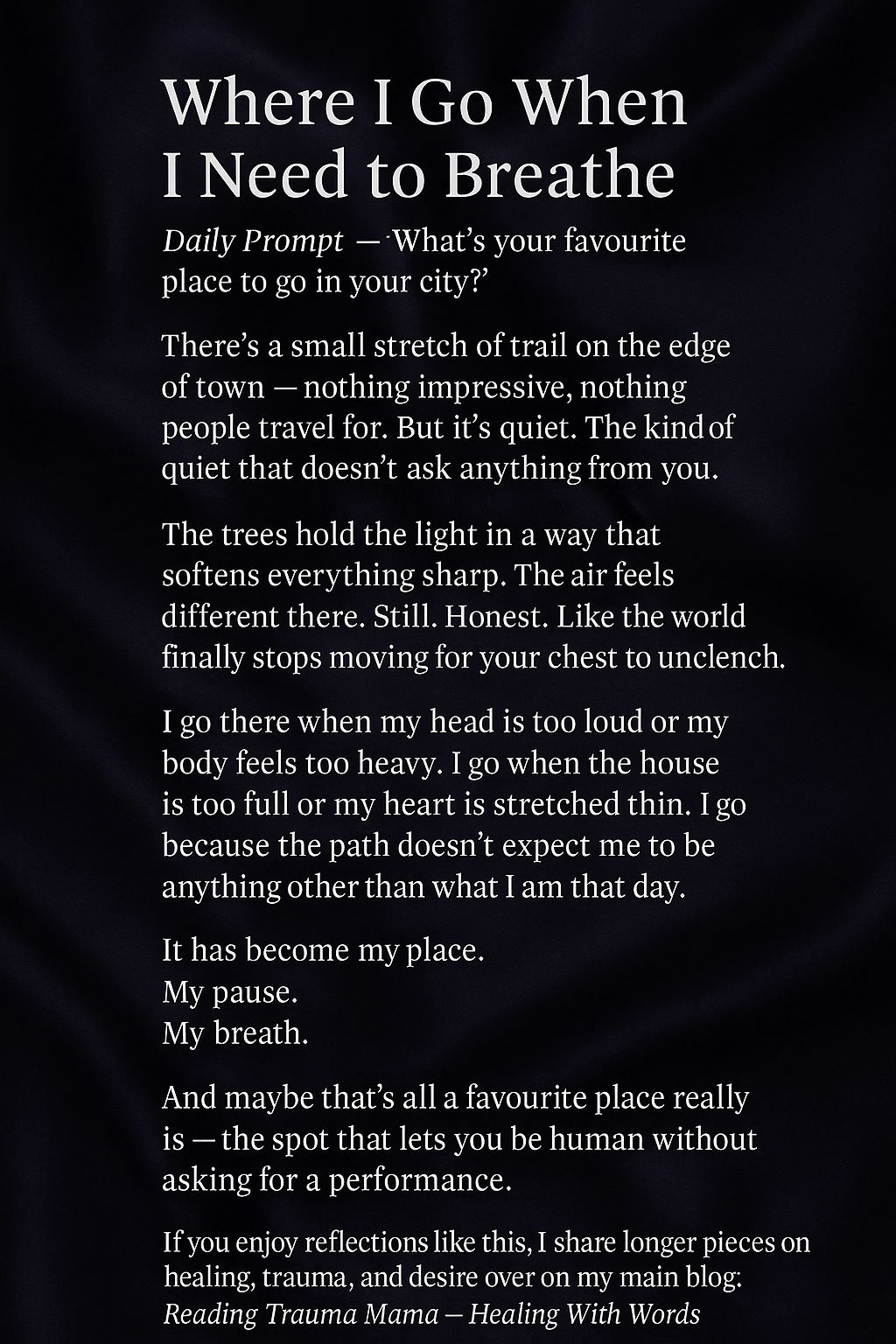
đź–¤ Where I Go When I Need to Breathe

What is your favorite place to go in your city?

There’s a small stretch of trail on the edge of town — nothing impressive, nothing people travel for. But it’s quiet. The kind of quiet that doesn’t ask anything from you.

The trees hold the light in a way that softens everything sharp. The air feels different there. Still. Honest. Like the world finally stops moving long enough for your chest to unclench.

I go there when my head is too loud or my body feels too heavy. I go when the house is too full or my heart is stretched thin. I go because the path doesn’t expect me to be anything other than what I am that day.

It has become my place.

My pause.

My breath.

And maybe that’s all a favourite place really is — the spot that lets you be human without asking for a performance.

⸻

🕯 If you enjoy reflections like this, I share longer pieces on healing, trauma, and desire over on my main blog: Reading Trauma Mama — Healing With Words.

đź–¤ Where the Last Ache Rests

The Anatomy of Desire — Act I

There comes a moment when even hunger grows quiet—

when the body no longer burns,

but hums with the memory of where the fire once lived.

You stop chasing the flame

and begin tracing its scars,

realizing that not everything that scorched you

was meant to destroy.

Some aches are eternal,

but they learn to rest—

softly,

deep beneath the skin,

like a devotion that never asked

to be healed,

only held.

đź–¤ The Hunger That Stayed

It wasn’t your touch that stayed with me—

it was the ache beneath it,

the quiet shiver your name left in my mouth,

the way it still rises like heat

at the edges of my breath.

Desire doesn’t die once it’s woken.

It settles in the hollow beneath the ribs,

patient as a shadow,

breathing for you

in the moments you pretend you’ve moved on.

Some hungers refuse to fade.

They deepen—

slowly,

silently,

with the weight of something that knows

it will be needed again.

There are fires that never burn out.

They wait—

steady,

unrushed,

alive beneath the ash.

A reminder that what was awakened in me

did not pass.

It learned to stay.

It learned my name.

And it learned how to burn

without ever asking permission.

The Afterglow

The Anatomy of Desire — Act I

The flames took what they could—

the walls I built to feel safe,

the certainty I clung to,

the versions of myself that begged

to be allowed to stay.

But in the ashes,

I found something almost holy:

a pulse that refused to die,

a quiet insistence that there was still more

of me left to become.

There is a certain beauty in ruin

when you rise from it willingly—

when you gather what remains,

hold it to the light,

and realize it still beats.

Scars become scripture.

Proof.

Testament.

A reminder that I survived the burning

and somehow,

even after everything,

still learned

how to burn for love.

The Fire Beneath Skin

The Anatomy of Desire — Act I

There is a strange beauty in the unraveling—

in the moment when defiance softens into need,

and the weight of control slips away

like silk leaving trembling fingers.

This is not defeat.

It is devotion turned inward,

a recognition that power does not vanish

when you release your grip—

sometimes it gathers.

Surrender is not the loss of self.

It is the meeting of the storm within,

the quiet opening of the heart

to whatever rises next.

It is the moment before the flame,

when breath stills,

and the body whispers its answer

before the mind dares to speak it.

To surrender is to lean into the fire

and say,

I am ready.

The Night We Stayed

The Anatomy of Desire — Act I

You were never meant to save me.

You were meant to ruin me—

beautifully,

deliberately,

with a gentleness that cut deeper than any cruelty ever could.

Each breath became a surrender.

Each glance, a quiet prayer

for the kind of destruction that feels like coming home.

Your touch was a contradiction—

a weapon wrapped in warmth,

a promise sharpened by hunger.

Your name tasted like sin on my tongue

and somehow still sounded like forgiveness

when whispered in the dark.

Some loves were never meant to heal us.

They were meant to devour—

to strip us down to the bone

until all that’s left

is the part of ourselves we were always too afraid to claim.

The part that is

unbroken,

unburied,

unapologetically

alive.

The Silence Between Us

The Anatomy of Desire — Act I

Every touch is a confession.

Even the smallest brush of skin holds a truth

the mouth is too afraid to speak.

Fingers remember what words forget.

They recall heat,

pressure,

the ghosts of moments that never fully happened—

yet live in the body as if they did.

There is honesty in trembling,

in breath held too long,

in the quiet hum between two people

who feel more than they are willing to admit.

The body never lies.

It aches where love once lingered,

and burns in the places still learning

what it means to trust again.

Touch becomes a language of its own—

one spoken in silence,

translated through longing.

And in that language,

we search for the one truth we fear and crave in equal measure:

that we are still

worth reaching for.

The Bruise and the Bloom

The Anatomy of Desire — Act I

Desire is not polite.

It does not wait its turn or soften its edges.

It claws,

it begs,

it takes—

leaving marks you feel long after the moment passes.

There is a strange beauty in the unraveling,

in the way restraint loosens thread by thread

until you are no longer separate from the hunger

but shaped by it.

To devour is to remember you are alive.

To be devoured is to remember

you have a pulse worth following.

Love does not whisper here.

It bites.

It breathes.

It presses in close until you forget

where you end

and the wanting begins.

This is not ruin—

not the kind that breaks you.

This is worship in its most feral form,

where bruise becomes bloom,

and every hunger

is a prayer answered in the dark.

The Edge of Surrender

The Anatomy of Desire — Act I

There is a moment before the fall—

barely a breath,

barely a tremor,

just a soft knowing in the chest

that you’ve already given in.

Surrender is not weakness.

It is a kind of courage,

the quiet kind—

the willingness to unclench,

to open,

to let yourself be seen

in the place where want first forms.

The body always knows before the heart admits it.

It tightens,

loosens,

leans.

Desire slips through the quiet like a thread,

pulling you toward what you swore

you were strong enough to resist.

And when surrender finally comes,

it is not loud.

It is not wild.

It is the soft, devastating ruin

of restraint breaking—

the moment you stop fighting

and let the wanting

win.

The Hunger Beneath Skin

The Anatomy of Desire — Act I

It begins as a whisper—

a pulse beneath the surface,

a thrum the body tries to hide

but never truly silences.

This is not the gentle ache of wanting.

This is hunger.

The kind that drags you toward the edge,

that breathes like a warning,

that tastes like the memory of a touch

you never actually had

but somehow still miss.

The body remembers what the mind refuses to name.

It recalls heat,

pressure,

the ghost of a hand that never lifted.

It carries desire like a bruise no one can see,

tender to thought,

violent to ignore.

Fingers twitch with the urge to trace what isn’t theirs,

to reach for what should remain untouched.

But desire and ruin often wear the same face,

and longing does not stay polite

once it finds a way beneath the ribs.

What lives under the skin

does not ask.

It claims.

And when it rises—

it devours.

The Pull

The Anatomy of Desire — Act I

There is a kind of touch that never happens,

yet somehow leaves fingerprints.

It lives in the inches between two bodies,

in the breath that hesitates,

in the look that lingers a moment too long.

Not enough to cross a line—

just enough to draw one.

Desire doesn’t announce itself.

It moves quietly,

like something half-remembered from another life—

a warmth behind the ribs,

a pressure beneath the skin,

a burning that pretends to be harmless.

He looks at her with a steadiness that should not ache,

but it does.

It feels like recognition,

like temptation wearing familiarity’s face.

And she answers with stillness,

because stillness is the only thing that keeps her from falling forward.

It is the distance that protects them.

It is the wanting that betrays them.

Every time their eyes meet, a boundary breaks—

not outwardly,

but inside the place where hunger is born

and never fully silenced.

Because some desires are not meant to be touched.

They are meant to haunt,

to shape you from the inside out,

to ruin your composure

while leaving your body untouched.

Some hungers feed themselves.

Some prayers go unanswered on purpose.

And some ruins feel like the beginning of something holy.

đź–¤ Introduction — The Hunger of Becoming

There are stories that rise quietly from the bones—

stories that ache, claw, and whisper their way through the dark

until the body can no longer hold them in silence.

This is not a story of healing,

nor is it one of redemption.

Those come later, in other lives.

This is the story of what lives beneath both—

the hunger that wakes first,

the want that refuses to die,

the pulse that survives every ruin.

It stirs when the silence has lasted too long.

It tastes like truth on the tongue

and burns like want beneath the skin,

reminding you that desire is not a sin

but a calling.

This is where the breaking becomes becoming—

where love, loss, and longing twist together

until they no longer know where one ends

and the other begins.

Welcome to The Hunger of Becoming—

a descent written in six acts,

each one a step deeper into the dark pulse of desire,

surrender,

and rebirth.

Enter gently.

The story remembers you.

đź–¤ What’s the first impression I want to give people?

What’s the first impression you want to give people?

I don’t want my first impression to be soft or easy.

I’m not interested in being the kind of woman

people can neatly define in a single glance.

I’d rather the air shift a little when someone meets me.

I want them to sense the weight I carry —

the shadows that made me,

the fire that kept me alive,

the truth I learned the hard way.

I want people to feel the contradiction in me:

the warmth that can hold you,

and the darkness that refuses to be silenced.

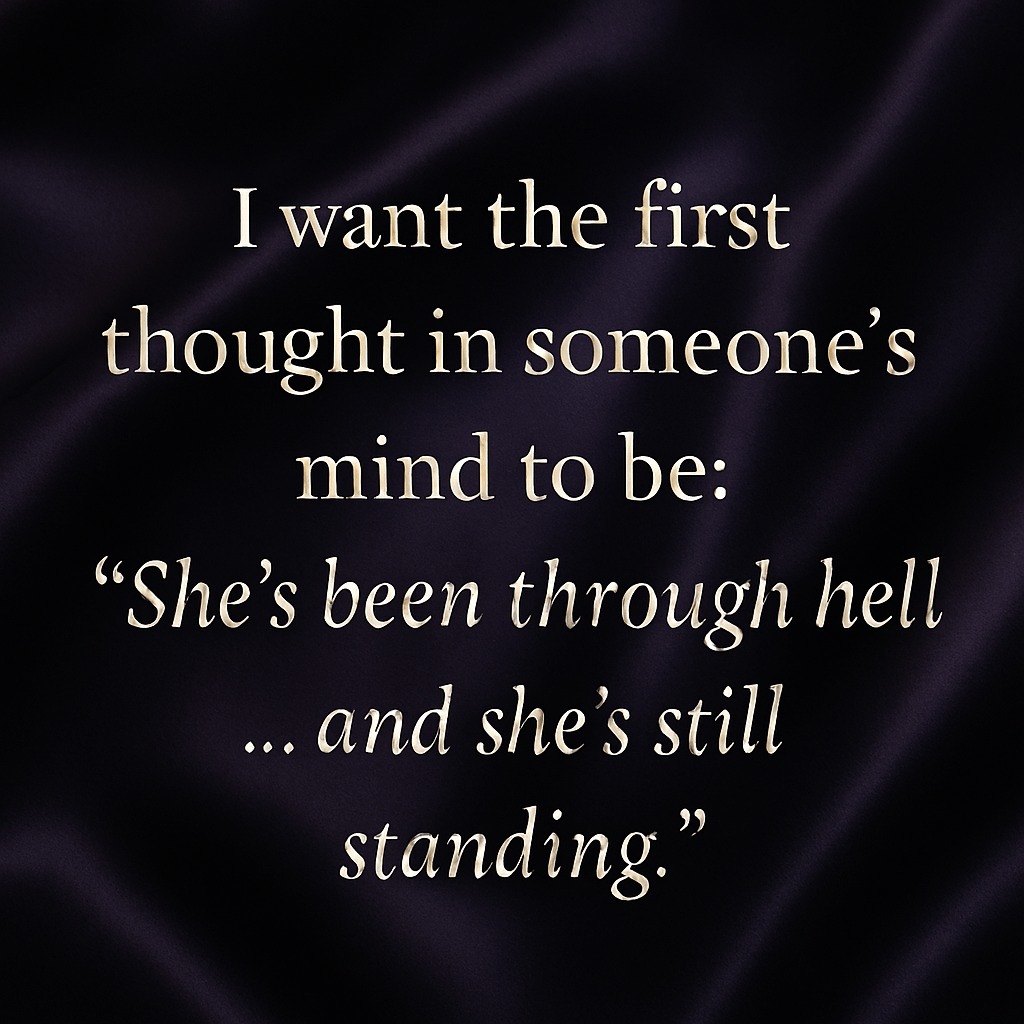
I want the first thought in someone’s mind to be:

“She’s been through hell…

and she’s still standing.”

Not fragile.

Not polished.

Not pretending.

Just real —

raw in a way that makes people stop,

listen,

and maybe recognize a piece of themselves

in the cracks I no longer hide.

My first impression isn’t meant to comfort.

It’s meant to wake something up.

Because I don’t walk into rooms trying to be understood.

I walk in carrying every version of myself,

and I let the world decide what it’s ready to see.

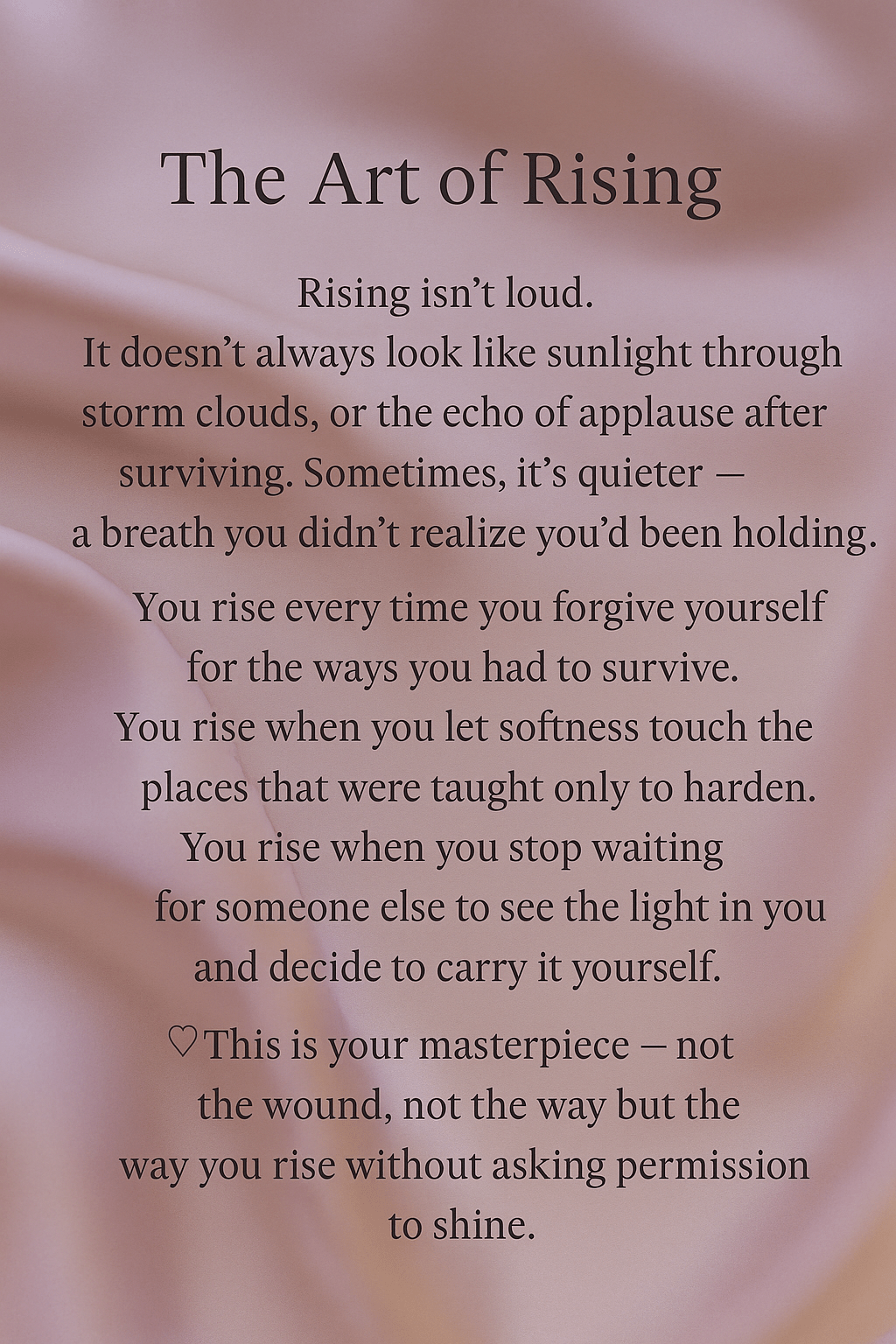
✨ Post Five — “The Art of Rising”

Rising isn’t loud.

It doesn’t always look like sunlight through storm clouds,

or the echo of applause after surviving.

Sometimes, it’s quieter —

a breath you didn’t realize you’d been holding.

You rise every time you forgive yourself

for the ways you had to survive.

You rise when you let softness touch

the places that were taught only to harden.

You rise when you stop waiting

for someone else to see the light in you

and decide to carry it yourself.

There is art in that —

in the small, stubborn act of choosing joy

after knowing only the ache of endurance.

There is grace in standing still

and realizing you are no longer running.

đź’Ś

This is your masterpiece —

not the wound, not the war,

but the way you rise

without asking permission to shine.

✨ Post Four — “The Woman Who Healed It”

There was a time you mistook silence for strength.

You carried your pain like proof of survival —

as if healing required you to be quiet about the places that hurt.

But healing was never meant to be silent.

It’s a language spoken in tears that finally dry,

in words that tremble their way into truth,

in the soft defiance of breathing again after being broken.

You’ve learned that the past doesn’t disappear —

it just softens its edges when you stop running from it.

You’ve learned that forgiveness isn’t surrender —

it’s setting yourself free from what you were never meant to carry.

And now, when you look in the mirror,

you no longer see the girl who was shattered —

you see the woman who gathered the pieces

and built something beautiful from the wreckage.

You are both the ache and the answer.

Both the wound and the woman who healed it.

You are everything they said would destroy you —

and somehow, you’re still here,

unafraid to bloom in the ruins.

đź’Ś

This is what survival looks like when it finally becomes peace.

✨ Post Three — “The Reclaiming”

You once believed healing meant forgiveness —

but now, you understand it’s about reclaiming what was yours

before anyone taught you to be small.

It isn’t about being soft all the time,

or graceful when you’re breaking.

It’s about choosing yourself

in every breath,

in every no,

in every moment you decide

not to shrink back into the person

they told you to be.

You are not the pain they caused.

You are the pulse that kept you alive

when no one else noticed you were fading.

There is power in survival,

but there is divinity in becoming.

You have become the storm and the stillness.

The wound and the wisdom.

The before and the after.

This is what it means to reclaim yourself —

not to return to who you were,

but to rise as who you were always meant to be.

đź’Ś

You are not healing anymore.

You are becoming.

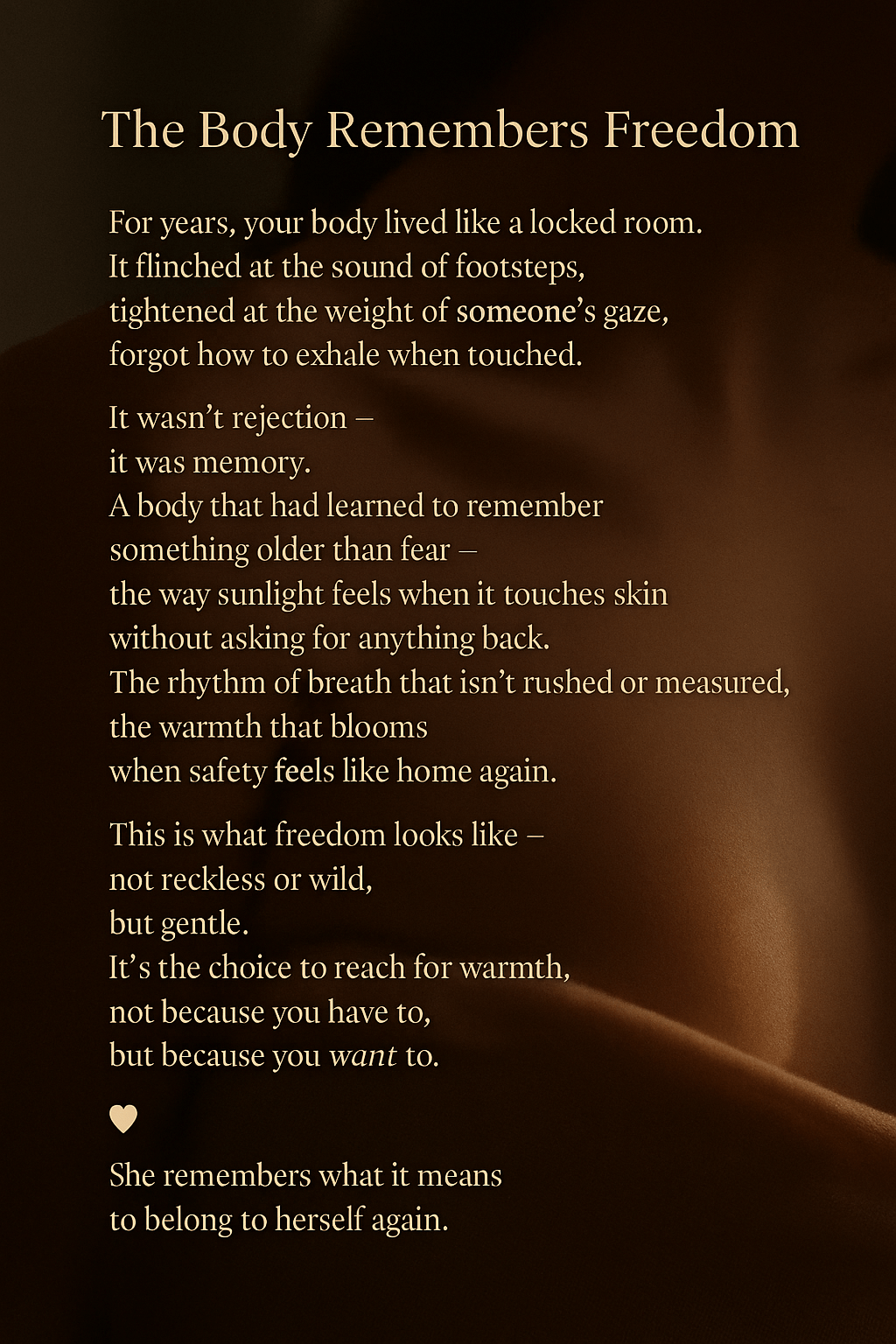
✨ Post Two — “The Body Remembers Freedom”

For years, your body lived like a locked room.

It flinched at the sound of footsteps,

tightened at the weight of someone’s gaze,

forgot how to exhale when touched.

It wasn’t rejection —

it was memory.

A body that had learned to protect you,

even from love.

But slowly, she began to remember something older than fear —

the way sunlight feels when it touches skin

without asking for anything back.

The rhythm of breath that isn’t rushed or measured,

the warmth that blooms

when safety feels like home again.

This is what freedom looks like —

not reckless or wild,

but gentle.

It’s the choice to reach for warmth,

not because you have to,

but because you want to.

The body always remembers —

pain, yes,

but also the way to heal.

And tonight, she moves

not out of survival,

but out of desire.

đź’Ś

She remembers what it means

to belong to herself again.

✨ Act III:

✨ Post One — “The Language of Power”

You used to speak in whispers.

Even your laughter felt like an apology —

a sound you offered only when it wouldn’t echo too loud.

But silence was never your native tongue.

You were born fluent in fire,

and it terrified the ones who could only love you small.

Power isn’t in the shouting —

it’s in the way your voice doesn’t tremble anymore

when you say no.

It’s in the way you walk away

without needing them to follow.

It’s in choosing softness

even when hardness would be easier.

You don’t raise your voice now —

you raise your boundaries.

You no longer explain what peace costs to those

who’ve never had to earn it.

You’ve become fluent again

in the language you were born to speak —

the quiet power of a woman who knows herself.

đź’Ś

And in that language,

every word sounds like freedom.

đź–¤ The Becoming

You do not rise from the ashes —

you bloom there.

The fire wasn’t your ending,

it was your initiation.

You’ve shed too many versions of yourself

to keep pretending you need saving.

There’s no redemption here —

only reclamation.

The softness you once hid

has turned into something sacred,

something untamed.

You love differently now —

not as surrender, but as choice.

They will call you changed,

as if evolution were a sin.

But this isn’t change —

this is you, unbound.

This is every version that survived,

stitched into something whole.

đź’Ś You are not what happened to you.

You are what became because of it.

And there is nothing fragile

about that kind of beauty.

đź–¤ The Quiet Ruin

Not every ending screams.

Some unravel in whispers,

the kind you only hear

when you finally stop trying to fix what’s already gone.

There’s a strange beauty in ruin —

in watching what once felt unshakable

collapse into something almost tender.

The ache softens when you realize

not every fracture needs repair.

You spent years building walls,

patching cracks, pretending strength meant silence.

But even stone erodes under the weight of pretending.

And maybe the truest kind of healing

isn’t rebuilding at all —

it’s learning how to stand still

in the wreckage

without losing yourself in the dust.

You are not broken beyond recognition.

You are the echo after the fall —

and somewhere in the quiet ruin,

you finally learn the language

of letting go.

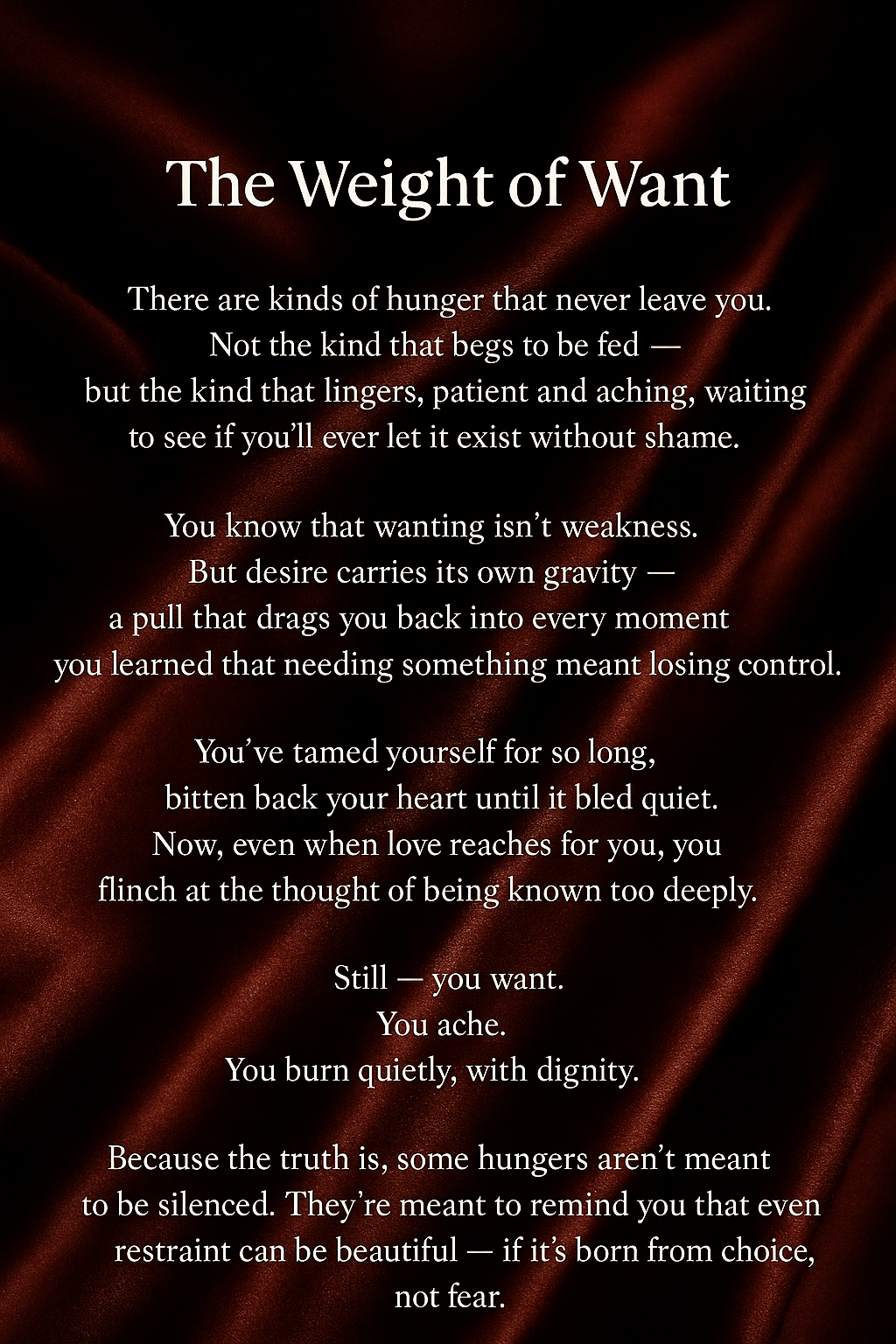
đź–¤ The Weight of Want

There are kinds of hunger that never leave you.

Not the kind that begs to be fed —

but the kind that lingers, patient and aching,

waiting to see if you’ll ever let it exist without shame.

You know that wanting isn’t weakness.

But desire carries its own gravity —

a pull that drags you back into every moment

you learned that needing something meant losing control.

You’ve tamed yourself for so long,

bitten back your heart until it bled quiet.

Now, even when love reaches for you,

you flinch at the thought of being known too deeply.

Still — you want.

You ache.

You burn quietly, with dignity.

Because the truth is,

some hungers aren’t meant to be silenced.

They’re meant to remind you

that even restraint can be beautiful —

if it’s born from choice, not fear.

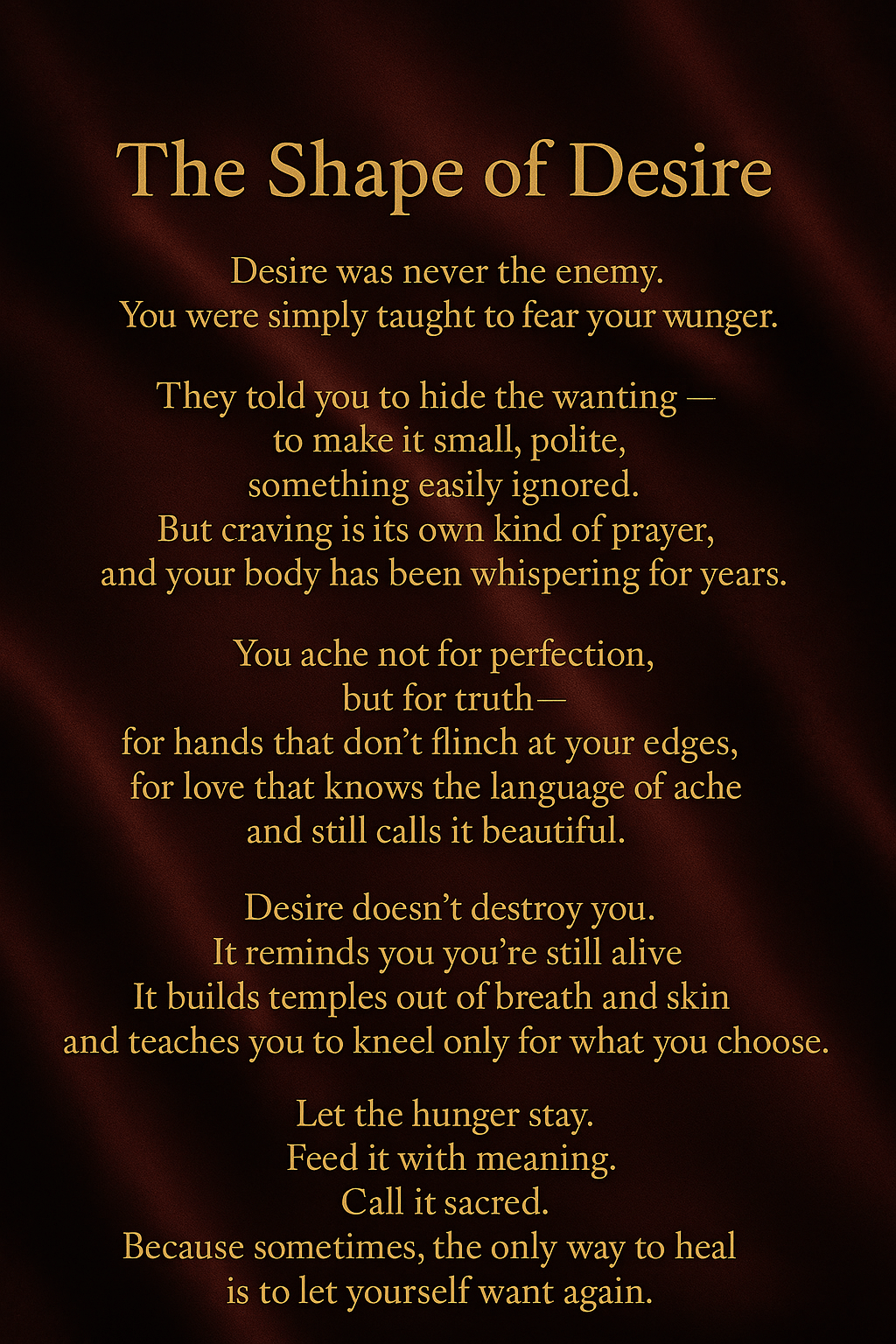
đź–¤ The Shape of Desire

Desire was never the enemy.

You were simply taught to fear your own hunger.

They told you to hide the wanting —

to make it small, polite,

something easily ignored.

But craving is its own kind of prayer,

and your body has been whispering for years.

You ache not for perfection,

but for truth —

for hands that don’t flinch at your edges,

for love that knows the language of ache

and still calls it beautiful.

Desire doesn’t destroy you.

It reminds you you’re still alive.

It builds temples out of breath and skin

and teaches you to kneel only for what you choose.

Let the hunger stay.

Feed it with meaning.

Call it sacred.

Because sometimes, the only way to heal

is to let yourself want again.

đź–¤ Act II

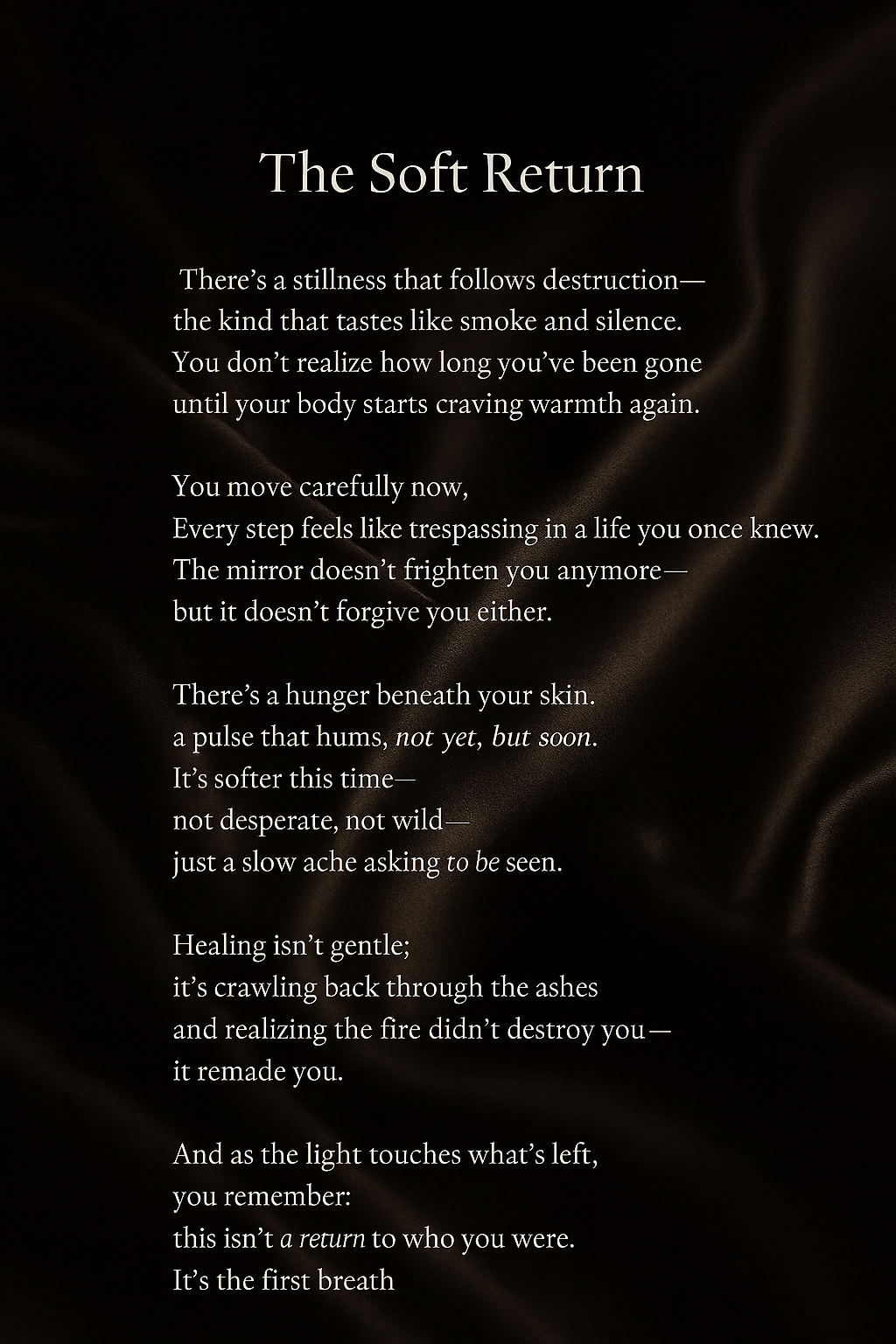
đź–¤ The Soft Return

There’s a stillness that follows destruction —

the kind that tastes like smoke and silence.

You don’t realize how long you’ve been gone

until your body starts craving warmth again.

You move carefully now.

Every step feels like trespassing in a life you once knew.

The mirror doesn’t frighten you anymore —

but it doesn’t forgive you either.

There’s a hunger beneath your skin,

a pulse that hums, not yet, but soon.

It’s softer this time —

not desperate, not wild —

just a slow ache asking to be seen.

Healing isn’t gentle;

it’s crawling back through the ashes

and realizing the fire didn’t destroy you —

it remade you.

And as the light touches what’s left,

you remember:

this isn’t a return to who you were.

It’s the first breath

of who you’re becoming.

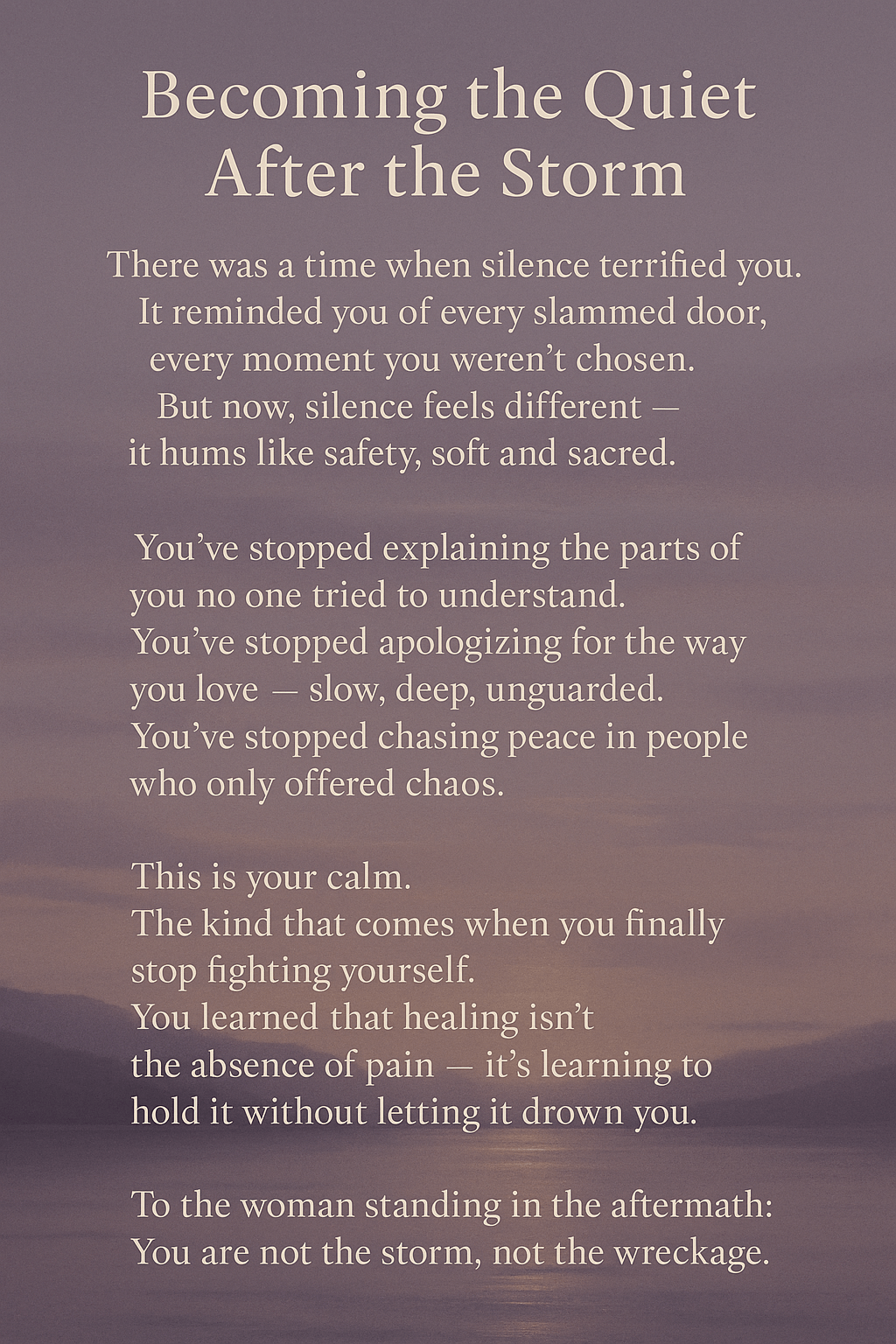
🌙 Post Five — “Becoming the Quiet After the Storm”

There was a time when silence terrified you.

It reminded you of every slammed door, every moment you weren’t chosen.

But now, silence feels different —

it hums like safety, soft and sacred.

You’ve stopped explaining the parts of you no one tried to understand.

You’ve stopped apologizing for the way you love — slow, deep, unguarded.

You’ve stopped chasing peace in people who only offered chaos.

This is your calm.

The kind that comes when you finally stop fighting yourself.

You learned that healing isn’t the absence of pain —

it’s learning to hold it without letting it drown you.

đź’Ś To the woman standing in the aftermath:

You are not the storm, not the wreckage.

You are the quiet that followed —

and that quiet is your power.

🌤 Post Four — “When You Finally See Yourself”

There comes a moment when the mirrors change.

When the reflection staring back isn’t a wound,

but a woman learning to love what she once tried to hide.

For years, you saw yourself through their words —

too quiet, too sensitive, too much.

You tried to fit into the outlines they drew for you,

until you realized you were never meant to be small enough to fit someone else’s version of you.

Now you see it — the strength in your softness,

the wisdom in your scars,

the power in your gentleness.

You are not the aftermath of what they did to you.

You are the continuation of everything they couldn’t destroy.

đź’Ś To the girl who became her own mirror:

You are the story they’ll never be able to rewrite.

And the reflection they’ll never recognize —

because this time, you belong entirely to yourself.

🌙 Post Three — “The Apologies That Weren’t Yours to Carry”

You spent years saying sorry for things that were never your fault.

For other people’s tempers.

For the silence that followed their storms.

For wanting too much, feeling too deeply, or simply existing in the wrong moment.

You made yourself small enough to fit their comfort.

You apologized for the chaos they created.

You wore guilt that didn’t belong to you like it was stitched into your skin.

But love — not every apology belongs to you.

You do not have to keep paying for what they refused to face.

Their inability to love you right was never your crime to confess.

Let it go — not for them, but for you.

The child inside you deserves to be free of borrowed shame.

And the woman you’ve become deserves to stand without flinching.

💌 You are not a wound to fix — you are the healing itself.

🌧 Post Two — “The Things You Weren’t Supposed to Feel”

They told you to be grateful.

For the roof, for the meals, for the chaos disguised as care.

They told you to smile when your heart clenched and call it love when it hurt.

But there were nights you lay awake wondering why love felt like walking barefoot across glass.

You wanted to cry, but the sound of your own pain scared you.

So you swallowed it whole — every tear, every question, every truth that didn’t fit their story.

You learned how to laugh through burning.

You learned that pretending was safer than being seen.

And even now, when someone reaches for you with kindness, a part of you still flinches — not because you don’t want love, but because you were taught to fear what came with it.

So this is your reminder, little one:

You were never too much for feeling.

They were just too small to hold it.

🌙 Act I: Echoes

Post One — “To the Girl Who Learned to Stay Quiet”

There was a time you believed silence kept you safe.

You learned early that soft voices survived longer — that shadows were kinder than the light that burned.

You carried the weight of too many grown-up words before you even learned how to spell them.

But here’s what you never knew, little one:

The quiet you built wasn’t weakness. It was armor. It was brilliance disguised as stillness.

Every time you held your breath to keep the peace, you were teaching yourself how to endure storms the world never saw coming.

You thought no one noticed you shrinking.

But I did.

And now — I am here to remind you that survival is not shame.

Your voice has always been your rebellion.

And this time, you don’t have to whisper.

✨ Introduction — “Becoming After the Break”

There comes a moment after the wreckage —

when the dust has settled, and the echoes have faded —

where you are no longer who you were,

but not yet who you are becoming.

This space between breaking and becoming

is not a void;

it is a quiet, sacred rebuilding.

This series, Becoming After the Break,

is a reflection of that slow resurrection —

of finding your way back to yourself

after the world, the past, or your own pain

has stripped everything familiar away.

Across three acts,

you will witness not perfection, but process.

You will find fragments of strength in surrender,

truth in the ruins,

and a soft, defiant hope rising through the cracks.

Each word is both confession and creation.

Each act, a step toward the light —

not to forget the darkness,

but to prove that even after it,

you can still bloom.

🌤 After the Breaking

When I started writing Beautifully Broken, I didn’t know how it would feel to let people see the pieces I’ve spent years trying to hide.

But I think that’s what healing really is — learning to live in the open again, even with the cracks showing.

Each post was a small act of release.

Each memory, a goodbye.

Each truth, a reminder that pain doesn’t disappear when we write about it — it transforms.

If you’ve read along, thank you.

If my words found you in your own healing, I hope they whispered one simple truth:

you’re not alone in the becoming.

I’m still learning to love all my unfinished edges —

but maybe that’s the point.

Maybe the breaking was never the end.

Maybe it was just where I started shining through.

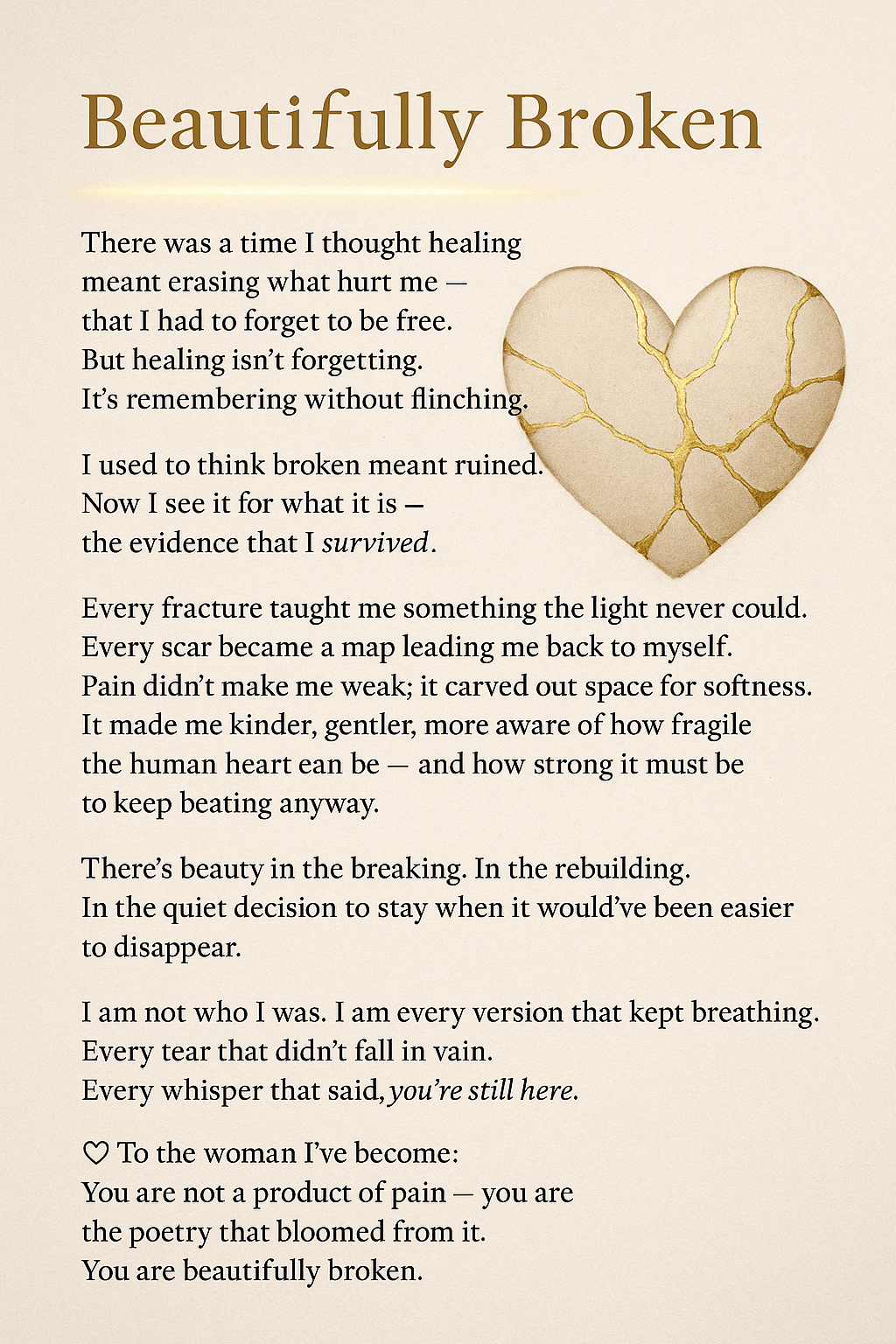
💔✨ Beautifully Broken

There was a time I thought healing meant erasing what hurt me —

that I had to forget to be free.

But healing isn’t forgetting.

It’s remembering without flinching.

I used to think broken meant ruined.

Now I see it for what it is —

the evidence that I survived.

Every fracture taught me something the light never could.

Every scar became a map leading me back to myself.

Pain didn’t make me weak; it carved out space for softness.

It made me kinder, gentler, more aware of how fragile the human heart can be —

and how strong it must be to keep beating anyway.

There’s beauty in the breaking.

In the rebuilding.

In the quiet decision to stay when it would’ve been easier to disappear.

I am not who I was.

I am every version that kept breathing.

Every tear that didn’t fall in vain.

Every whisper that said, you’re still here.

💌 To the woman I’ve become:

You are not a product of pain —

you are the poetry that bloomed from it.

You are beautifully broken,

and that is your greatest strength.

🌹 The Girl Who Stopped Apologizing

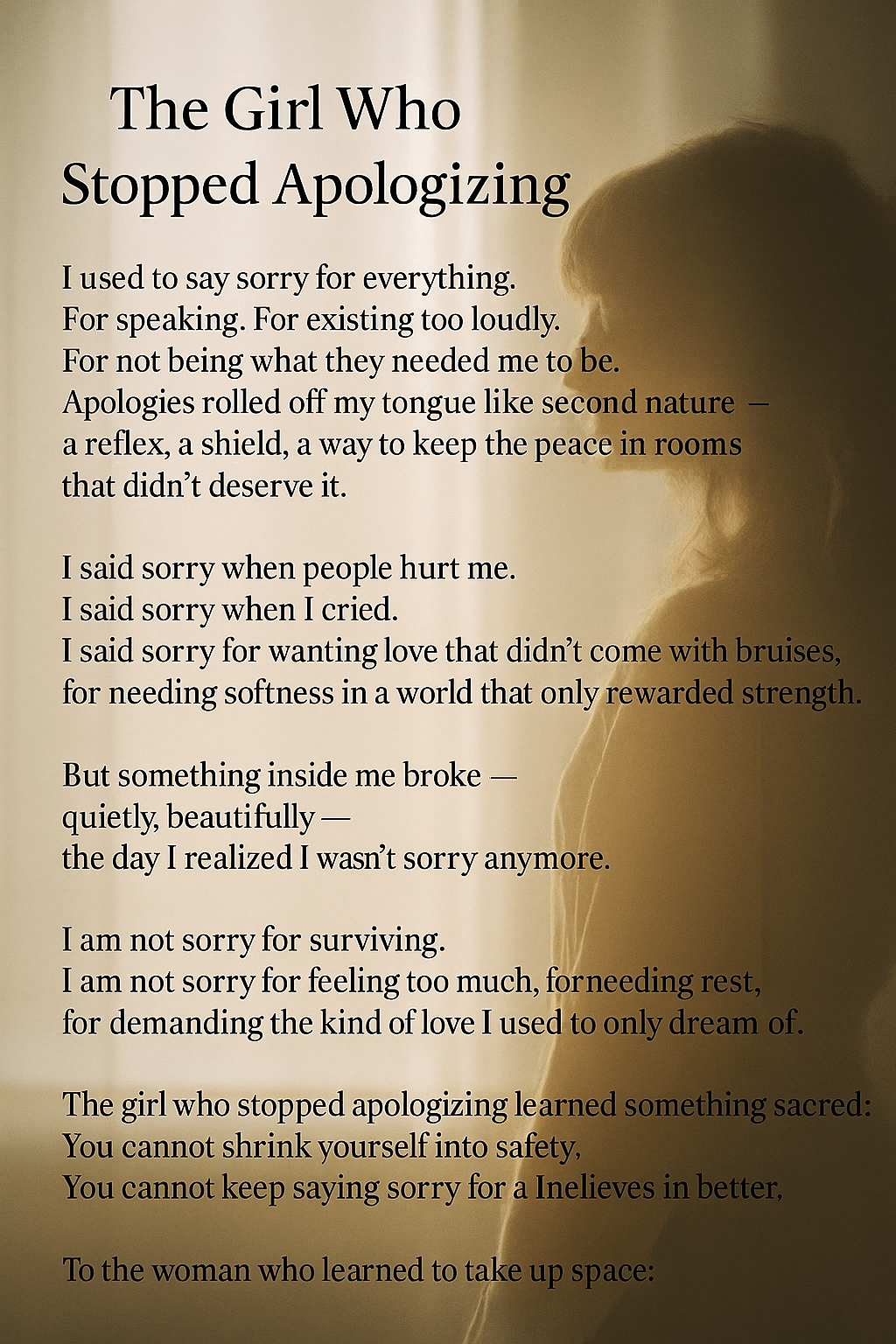
I used to say sorry for everything.

For speaking.

For existing too loudly.

For not being what they needed me to be.

Apologies rolled off my tongue like second nature —

a reflex, a shield, a way to keep the peace in rooms that didn’t deserve it.

I said sorry when people hurt me.

I said sorry when I cried.

I said sorry for wanting love that didn’t come with bruises,

for needing softness in a world that only rewarded strength.

But something inside me broke —

quietly, beautifully —

the day I realized I wasn’t sorry anymore.

I am not sorry for surviving.

I am not sorry for feeling too much, for needing rest,

for demanding the kind of love I used to only dream of.

The girl who stopped apologizing learned something sacred:

You cannot shrink yourself into safety.

You cannot keep saying sorry for a heartbeat that still believes in better.

đź’Ś To the woman who learned to take up space:

You don’t owe anyone an apology for being whole.

You are not a burden — you are the consequence of your own courage.

And you deserve to stand in the light without flinching.

đź–¤ The Language of Bruises

There was a time I thought love sounded like an apology.

That affection came after the hurt —

that pain was the proof I was worth returning to.

No one teaches you that survival has its own dialect.

It’s the way your body flinches before your mind catches up.

It’s learning how to smile through a tremor,

how to hide a scar beneath grace.

I spoke fluently in silence and endurance.

My body remembered words my mouth never said.

Every bruise was a sentence.

Every scar, a paragraph carved into the skin of my past.

But bruises fade, even when memory doesn’t.

And one day, I realized that I didn’t have to keep translating pain into proof.

That love doesn’t have to hurt to be real.

Now, my body speaks softer languages —

laughter that echoes without fear,

touch that doesn’t demand apology,

a heart that knows peace isn’t quiet, it’s safe.

đź’Ś To the one who learned love through pain:

You are not broken for needing gentleness.

You are not hard to love —

you were just never spoken to in your native tongue.

đź•° The Things We Carry

When you grow up unheard,

you learn to hold conversations in your head.

I used to whisper to myself in the dark —

not out of madness, but survival.

I was the only one who listened.

I carried everything:

the secrets, the tension, the fear of saying the wrong thing.

I carried the sound of slammed doors,

and the silence that followed like a punishment.

I carried dreams I was told were too big,

and guilt that was never mine to keep.

It’s strange how the body remembers what the mind tries to forget.

My shoulders still tighten when voices rise.

My stomach still knots at the word lazy.

Every ache has an origin,

every tremor a memory trying to speak.

Sometimes I still talk to myself.

But now, the voice is softer —

less about surviving, more about soothing.

She reminds me that the load was never mine alone.

That I can set it down.

That I can rest.

đź’Ś To the child who carried too much:

You don’t owe the world your strength.

You were never meant to hold it all.

It’s okay to be tired.

It’s okay to be free.

🌫 The Art of Disappearing

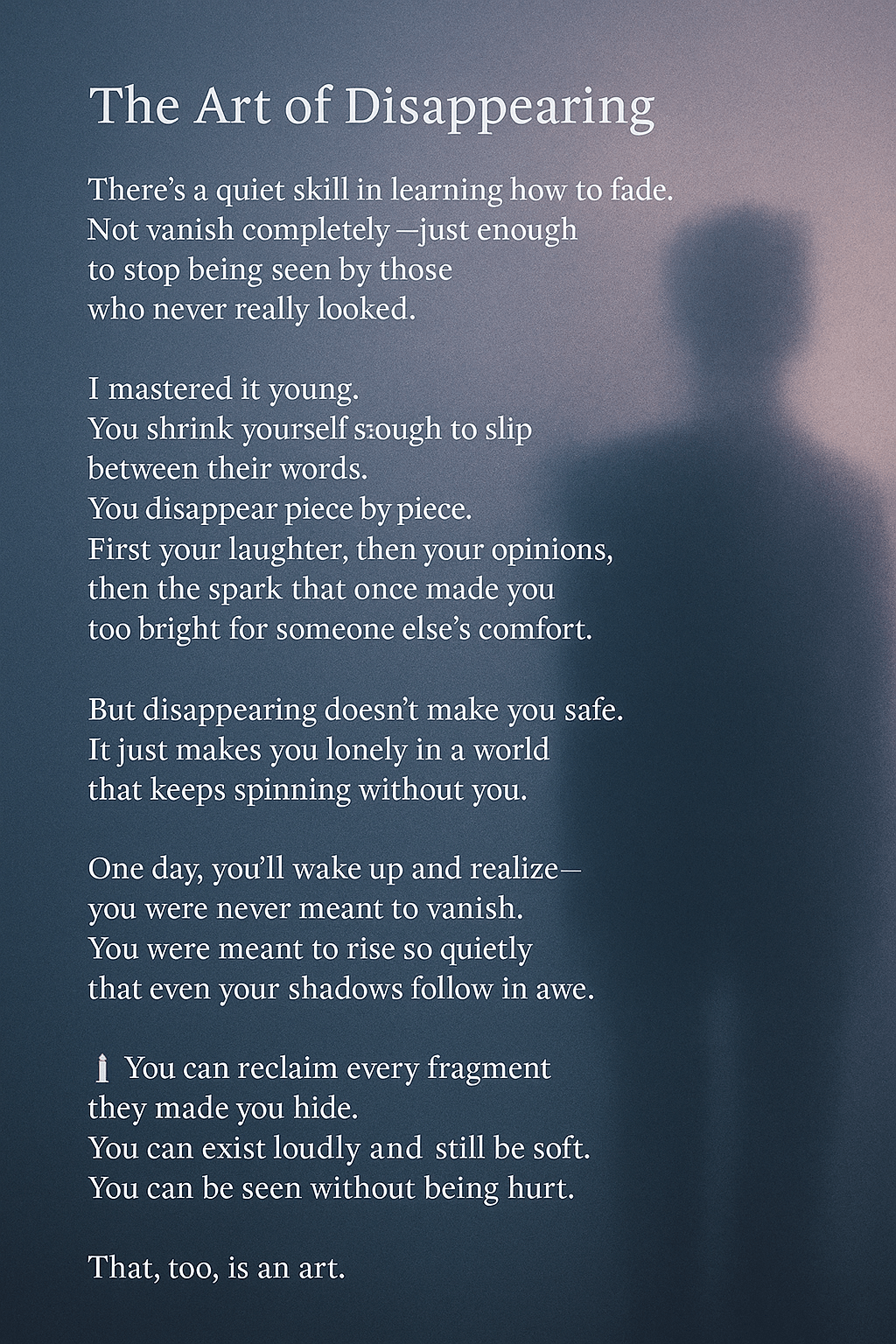
There’s a quiet skill in learning how to fade.

Not vanish completely — just enough to stop being seen by those who never really looked.

I mastered it young.

You shrink yourself small enough to slip between their words.

You learn to move without sound,

to hold your breath when the room grows sharp.

It feels like safety — until it starts feeling like absence.

You disappear piece by piece.

First your laughter, then your opinions,

then the spark that once made you too bright for someone else’s comfort.

It’s strange how invisible becomes a habit.

How being unseen starts to feel easier than being misunderstood.

But disappearing doesn’t make you safe.

It just makes you lonely in a world that keeps spinning without you.

One day, you’ll wake up and realize —

you were never meant to vanish.

You were meant to rise so quietly that even your shadows follow in awe.

🕯 You can reclaim every fragment they made you hide.

You can exist loudly and still be soft.

You can be seen without being hurt.

That, too, is an art.

🌑 The Weight of Silence

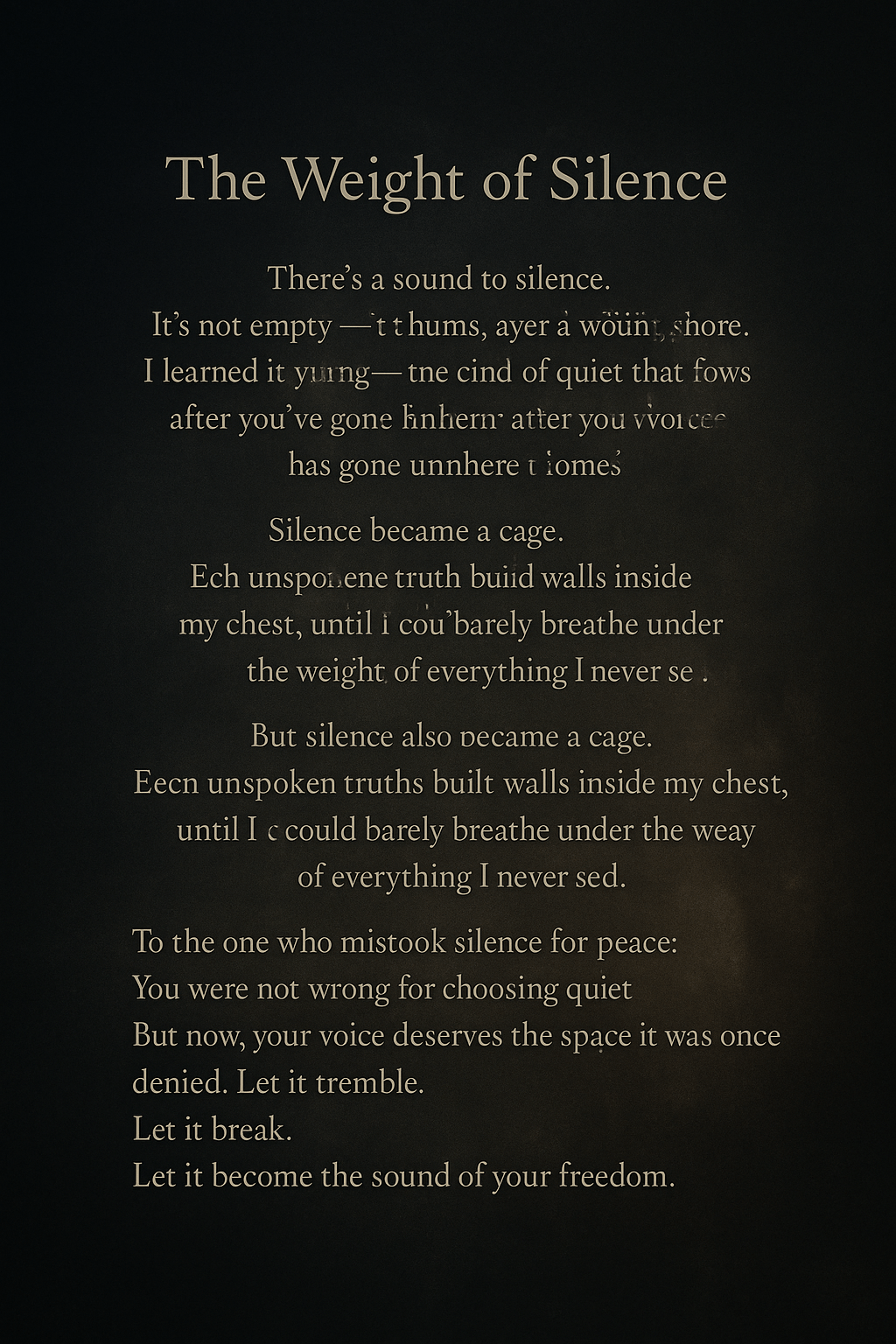
There’s a sound to silence.

It’s not empty — it hums, low and constant, like a wound still trying to close.

I learned it young — the kind of quiet that follows after you’ve cried yourself hoarse,

after your voice has gone unheard too many times to try again.

Silence became safety.

If I didn’t speak, they couldn’t twist my words.

If I stayed small enough, still enough,

maybe the chaos would pass me by.

But silence also became a cage.

Each unspoken truth built walls inside my chest,

until I could barely breathe under the weight of everything I never said.

Even now, I still pause before speaking —

still test the air to see if it’s safe.

It’s strange how something that once protected you

can slowly start to suffocate you.

đź’Ś To the one who mistook silence for peace:

You were not wrong for choosing quiet.

You were surviving in the only way you knew how.

But now, your voice deserves the space it was once denied.

Let it tremble.

Let it break.

Let it become the sound of your freedom.

🪞 The Mirror of Becoming

There’s a moment, quiet and merciless, when you finally see yourself.

Not the caretaker.

Not the survivor.

Not the woman built from obligation —

but the one buried beneath her.

I used to fear mirrors.

They showed me what years of endurance looked like:

the hollow eyes, the practiced smile,

the woman who never stopped performing “fine.”

But healing, I’ve learned, isn’t a gentle unveiling.

It’s standing naked before the truth —

seeing the cracks, the rage, the exhaustion —

and choosing not to turn away.

The mirror doesn’t lie, but it also doesn’t judge.

It waits.

It reflects the ache of the child still inside,

begging to be seen without having to earn it.

And maybe that’s the becoming —

not a rebirth, but a reclamation.

Learning to meet your own gaze without flinching.

To touch the scars and say, I made it through.

đź’Ś To the woman who feared her own reflection:

Your reflection is not your ruin.

It’s the proof that you lived —

that every fracture caught the light

and became something worth looking at.

🕯 When Home Became a Role, Not a Place

I was never just a daughter — I was the keeper of peace, the fixer of chaos, the stand-in for love that never came.

Home wasn’t comfort; it was a performance.

A fragile play where I learned to smile on cue,

to keep the house from collapsing under the weight of other people’s sins.

I cooked dinners I was too empty to eat.

I held crying children while no one held me.

I learned that if I was quiet enough,

strong enough,

needed enough —

maybe they’d finally see me.

But they didn’t.

They mistook endurance for devotion.

They called obedience maturity.

They praised me for being so good

at pretending I wasn’t breaking.

Sometimes, I still feel her inside me —

that girl who can’t sit still when something’s wrong,

who measures her worth by how much she can carry.

I tell her now, gently,

that she doesn’t owe the world her strength.

That she can set down the things she picked up out of fear.

đź’Ś To the woman who became home for everyone else:

You have nothing left to prove.

You are allowed to crumble and rebuild as many times as it takes.

You are not their savior.

You were their shelter.

And that was enough.

🕯 The Girl Who Grew Too Soon

Some children are born to play.

Others are born to hold the world together before they even understand its weight.

I was still learning how to braid my own hair

when I started tying shoes that weren’t mine.

Still a child,

but already someone’s protector.

They said I was mature for my age —

a compliment that tasted like exhaustion.

No one saw that every “good job”

was another layer of childhood I’d lost.

I remember late nights,

tiny hands reaching for mine,

the unspoken promise that I wouldn’t let them fall.

And I didn’t.

But somewhere in keeping everyone else safe,

I forgot how to feel safe myself.

đź’Ś To the girl who grew too soon:

You were never meant to be their anchor —

you just didn’t want them to drown.

You carried love the only way you knew how:

by holding on too tightly to everyone but yourself.

It’s okay to let go now.

It’s okay to rest.

The Years They Called Safe

Some people talk about childhood like it was all sunshine and scraped knees.

Mine feels more like a blur of doorways —

places I passed through,

trying to figure out which one meant “home.”

They told me I was safe now.

New house, new rules.

Foster care.

On paper, it sounded like rescue.

In my chest, it felt like waiting.

Waiting to see if this was another place I’d have to survive.

I still remember the way I watched other kids play —

really play —

like the world didn’t have teeth.

I wanted to join them,

but part of me stayed standing at the edge,

one foot in the game,

one foot still in the past.

Those were the years I almost learned how to be a child.

Almost.

Before responsibility came knocking again.

Before “can you help with them?”

turned into “they need you more than you need yourself.”

đź’Ś To the girl who never got to finish being little:

You didn’t imagine the weight you carried.

You didn’t exaggerate the fear.

You were not overreacting —

you were adapting.

And none of it was your fault.

You deserved to stay small a little longer.

I’m so sorry no one let you.

🕯 The House That Forgot to Love

Some wounds don’t scream anymore — they whisper.

They hum beneath the surface when the world gets too quiet,

reminding me that even silence can sound like fear.

I grew up learning that love had rules.

Don’t ask. Don’t cry. Don’t need.

The air in that house was thick with smoke and secrets.

Each day felt like walking on glass barefoot —

trying to stay small enough not to be seen,

yet desperate for someone to finally notice.

There are memories I don’t talk about —

not because I’ve forgotten them,

but because they still sit heavy behind my ribs,

waiting for permission to breathe.

The kind that come back in flashes —

a slammed door, a raised voice,

the sound of my own heart trying to hide inside itself.

But I’ve learned something in the years since:

survival and love are not the same thing.

You can grow up in chaos and still crave calm.

You can be born into pain and still choose tenderness.

So this is for her — the little girl who carried herself

through nights that felt longer than life.

The one who became her own parent before she could spell the word.

You were never broken, only buried.

And I am here now,

unearthing you gently,

so you can finally rest in the kind of love you always deserved.

🌙 Before You Begin — A Note from My Heart

This series, Beautifully Broken, explores the quiet truths that shaped me — the pain, the healing, and the pieces I once believed were beyond repair.

It speaks of childhood wounds, self-worth, and the long, imperfect road to rediscovering love — for myself and for others.

Some reflections touch on trauma, emotional neglect, and the lingering echoes of survival. Please take care of your heart while reading.

If you need to step away, breathe, or come back later — do that. Healing doesn’t need to be rushed.

This isn’t a story about pain —

it’s a story about what can grow through it. 🌸

🕯️ When Love Demands Silence

Sometimes love isn’t spoken.

It’s the ache that lingers when words fail — the way your hand still searches for theirs in the dark.

It’s the surrender between two souls who have fought, broken, and still found their way back.

Love is not always gentle.

It can be raw.

It can be ruin wrapped in devotion.

But in that ruin, something unexplainably beautiful survives — the part of you that refuses to stop believing.

Tell me…

When love demands silence, how do you answer?

Do you stay and listen to the ache, or walk away to save what’s left of you?

I’d love to hear your truth in the comments below. 🖤

đź’¬ How Do You Hold Love?

We all love differently.

Some with words, others through silence.

Some through presence — the kind that doesn’t need to be loud to be felt.

Today, I want to ask you something simple but deep:

How do you hold love when it gets heavy?

Do you reach out and cling tighter…

or do you pull back and protect what’s left of you?

There’s no wrong answer here — only the truth of your heart.

Share your thoughts below. I love reading the ways you all love, hurt, and heal. đź’—

🌸 The Way We Hold Love

After learning how we give and receive love,

I’ve learned that real love isn’t just warmth — it’s shadow, too.

It’s the soft ache of staying when your heart whispers run,

and the quiet strength of choosing tenderness after being cut by your past.

To be loved deeply means to be seen —

even by the parts you swore you’d never show again.

It means letting their hands find what’s fragile,

and trusting they won’t turn away when it trembles.

Marriage has a way of peeling you open —

not to break you, but to reveal the truth beneath the survival.

Love isn’t the absence of darkness;

it’s the hand that reaches through it.

Sometimes it’s a prayer whispered between heavy breaths.

Sometimes it’s the promise that even the bruised parts of you

can still be held — and still be wanted.

đź–¤ When Silence Touches Back

There’s a kind of silence that speaks —

when hands replace words

and every breath says stay.

Your touch is a question and an answer.

A plea and a promise.

It’s where I stop being a thought

and become a feeling.

Sometimes love is quiet —

not soft, but reverent.

The kind that trembles beneath the weight of wanting,

where skin remembers what the heart tries to forget.

🖤 A reflection on physical touch as confession —

where silence learns how to speak through the body.

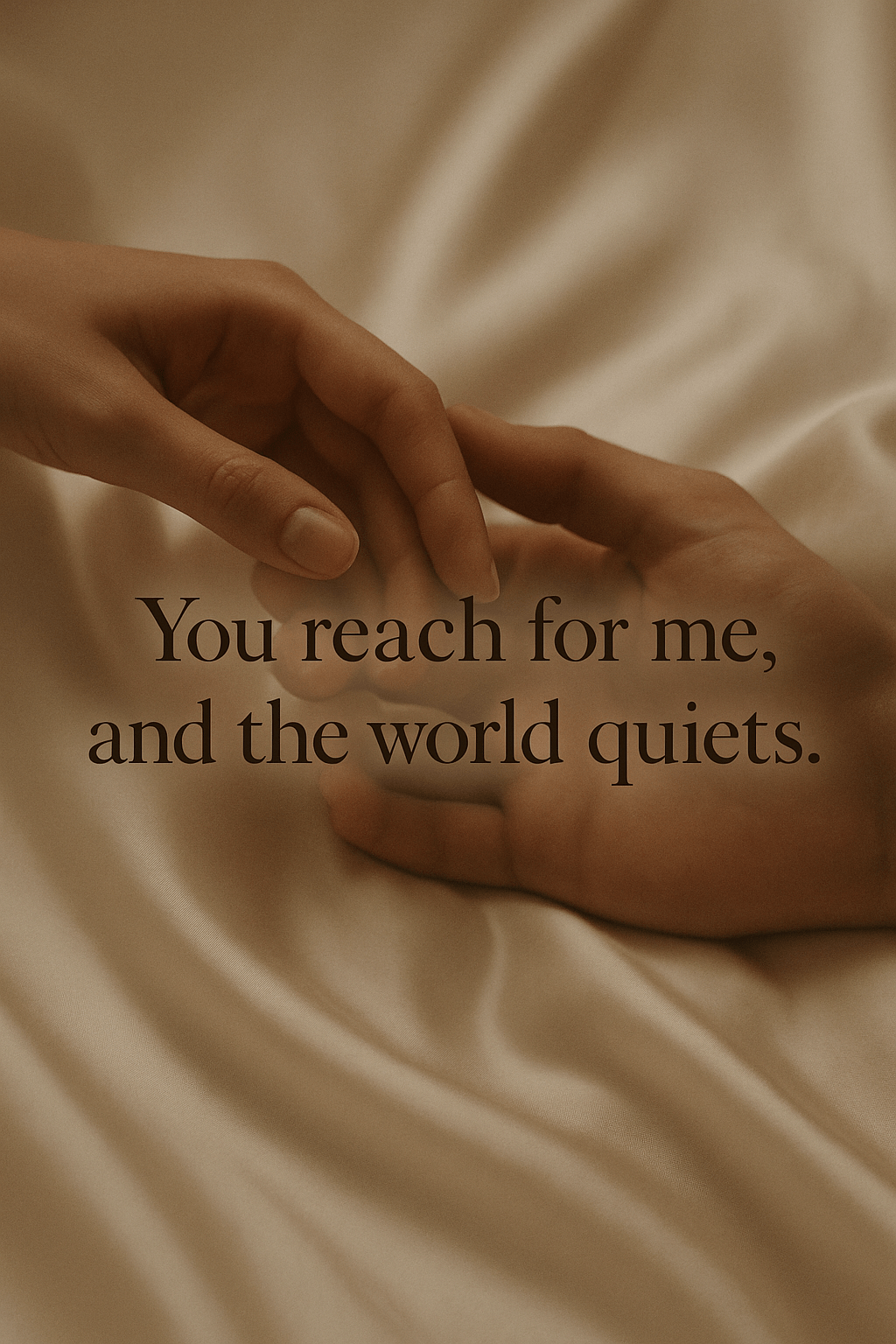
✨The Way You Reach for Me

It’s in the brush of fingertips, the way a hand finds mine without thinking.

No grand gestures, no promises — just presence.

You reach for me, and the world quiets.

Because sometimes love isn’t spoken;

it’s felt in the places words can’t reach.

✨ A reflection on love as touch —

how the smallest contact can rewrite a moment.

đź–¤ What We Give in Surrender

Every gift has a weight —

not in what it costs,

but in what it means to hand it over.

You give me things that aren’t wrapped —

your time, your patience, your restraint.

You offer the pieces of yourself

you once swore no one would ever touch again.

And I give back

in silence, in skin, in the way I look at you

when words would only ruin it.

Love like this isn’t about exchange.

It’s about trust —

about letting someone see the parts you’ve hidden

and hoping they hold them

like something sacred.

Because the real gift

isn’t what’s given.

It’s what’s risked.

🖤 A reflection on giving as surrender —

where every offering is a confession disguised as devotion.

✨ The Small Offerings

It was never about the size of the gift.

It was the thought —

the way you noticed the little things,

the quiet ways you say I see you.

You give without needing to impress.

A favorite tea left waiting,

a book you knew I’d love,

a touch that arrives without demand.

Maybe that’s what love really is —

not the grand gestures,

but the offerings made with intention.

Little reminders that say:

You matter enough to be remembered.

Because in a world that keeps rushing,

to pause long enough to give something that means something —

that’s the rarest kind of gift.

🕊 A reflection on the beauty of giving not for show, but from the soul.

đź–¤ The Devotion in Obedience

There’s a kind of service that isn’t about duty —

it’s about desire.

About knowing what the other needs

before the words ever reach their lips.

You touch me like worship,

like every small act is a prayer answered in movement.

And I give in — not because I’m weak,

but because there’s freedom in being seen that completely.

Obedience, in love, isn’t submission to power.

It’s surrender to trust —

a quiet vow whispered between skin and soul,

that says I am yours to care for,

and you are mine to serve.

Love like this isn’t loud.

It’s sacred, deliberate —

a rhythm of give and receive

that leaves no room for ego,

only devotion.

🖤 A reflection on service as surrender —

where love becomes both offering and altar.

✨ The Quiet Things You Do

Love doesn’t always arrive with grand gestures.

Sometimes, it’s in the softest things —

the way you remember how I take my coffee,

the warmth waiting when I’ve had a long day,

the silence you hold so I can find my peace again.

You’ve never needed to say “I love you” a hundred times,

because I see it

—in every small act that says, I’m thinking of you.

There’s something sacred in that quiet giving,

in the way your hands learn the rhythm of care

and your heart chooses me

in every unspoken moment.

Love, at its truest,

isn’t about what’s done for show —

it’s what’s done in stillness,

when no one’s watching but the one who matters most.

🕊 A reflection on devotion expressed through simple, intentional care.

đź–¤ The Hours Between Our Hunger

Time moves differently between us.

It bends, stretches, holds its breath —

waiting for the next touch, the next word we never say out loud.

There’s a kind of ache that grows

in the spaces we don’t fill.

A silent wanting that tastes like restraint,

like devotion disguised as distance.

We sit together,

pretending the air isn’t thick with everything we’re not saying —

every look, every almost,

every second that hums with what could happen if we just let go.

Because sometimes love isn’t gentle.

It’s the waiting that wrecks you,

the wanting that teaches you how to breathe slower

just to survive the silence.

🖤 A reflection on time as desire —

where presence becomes the most dangerous form of devotion.

✨ Where Stillness Becomes Us

Time has a way of revealing the truth —

who stays, who drifts,

and who learns to find meaning in the quiet between.

Love doesn’t always need to be spoken or touched.

Sometimes it’s felt in the rhythm of shared silence —

in the way two hearts sync without a single word.

To sit beside someone

and not feel the need to fill the space —

that’s a rare kind of peace.

The kind that doesn’t demand,

but simply is.
Because when love feels like stillness,

you realize it’s not about the hours spent together —

it’s about how safe it feels to stop counting.

🕊 A reflection on presence as love —

the kind that asks for nothing, yet gives everything.

đź–¤ The Sound of My Name in Your Mouth

There’s a different kind of power in words —

the kind that doesn’t comfort, but consumes.
The way my name sounds when you say it —

low, deliberate,

like it was meant to live on your tongue.

Every syllable becomes confession,

every breath a promise I can’t unhear.

You don’t just speak to me —

you unravel me.

Because sometimes, love isn’t whispered softly.

Sometimes, it’s claimed —

in the heat between want and worship,

in the echo of my name

as it falls from your mouth

like prayer and possession all at once.

🖤 A reflection on how words can both heal and hunger —

and how being known can feel like surrender.

✨ What We Speak into Love

Words have always been my safest place —

but also the sharpest.

They’ve broken me, healed me,

and reminded me that love isn’t just something we feel —

it’s something we speak into being.

To love someone through words

is to give them the language they never had growing up.

To whisper, “you’re enough”

into the places where they were once made to feel small.

To tell them, “you’re safe here,”

and mean it with your entire body.

The right words don’t fix us —

they find us.

And sometimes, being found

is the bravest thing love can do.

🕊 A reflection on how words can become home —

when they’re spoken by someone who chooses to stay.

The Mercy in Ruin

We were never built for gentle.

We were made for the kind of love that claws,

that breaks,

that rebuilds what it ruins.

Every touch has been a question:

Will you still want me when the light finds my scars?

And every time, you answer the same —

not in words, but in the way your hands refuse to let go.

Maybe this is what mercy feels like —

not forgiveness,

but understanding.

A quiet surrender to the chaos that made us.

You and I,

we don’t need saving.

We just need to keep choosing each other

in the wreckage.

🖤 A reflection inspired by Rina Kent and H.D. Carlton — love that doesn’t pretend to be pure, only true.

The Way You Stay

It’s never been about grand gestures.

It’s about the way you reach for me in passing —

fingers brushing, eyes meeting,

the quiet reminder that love can live in small things.

You’ve seen me in every version of myself,

and still, you stay.

Not to fix or change me,

but to walk beside me while I learn to trust the light again.

Maybe that’s what real love is —

not the promise of forever,

but the choice we keep making,

even when the world forgets how to be kind.

✨ A reflection inspired by Sara Cate — love that endures not because it’s easy, but because it’s real.

The Ache Between Us

You look at me like I’m both sin and salvation —

and I still haven’t decided which one I want to be for you.

Every word between us is a line drawn too close,

every silence, a dare.

You reach for me like a promise you shouldn’t keep,

and I let you,

because wanting you feels like breathing in lightning.

There’s a cruelty in this kind of closeness —

how it strips us down to truth.

You don’t just touch me;

you unravel me.

🖤 A reflection inspired by Rina Kent — where temptation and truth blur, and love lives in the ache between control and surrender.

Where Soft Meets Safe

Not every night is made for fire.

Some are made for slow breaths and tangled quiet,

for hearts that don’t need to prove anything to be heard.

You pull me close,

and suddenly the world stops asking us to be more.

Here, it’s enough to just be.

Love doesn’t always roar.

Sometimes it hums —

low, steady, and certain,

like the sound of safety in your chest.

✨ A reflection inspired by Sara Cate — the sweetness of stillness, where softness becomes strength.

What the Fire Didn’t Take

We survived the flames,

but something in us still smolders.

You press your palm against my scars,

and for a heartbeat, I forget which of us was burned first.

Love shouldn’t hurt — but sometimes it has to.

It has to break what’s brittle,

has to make us remember how we bled together

before we learned how to hold gently again.

Every time I pull away,

you drag me back with a whisper that sounds like a promise —

or a warning.

And I come anyway.

🖤 A reflection inspired by Rina Kent and H.D. Carlton — where love endures through the burn and passion becomes the proof of survival.

When We Find Our Way Back

Some days we drift —

not because we stop loving,

but because life gets loud.

Yet somehow, you always reach for me

in the quiet that follows.

No words, just presence.

No grand gestures, just the warmth

of knowing we still choose each other.

You trace my scars like they’re a map

you’ve already memorized,

and every time you whisper my name,

it sounds like home.

✨ A reflection inspired by Sara Cate — love that wanders, forgives, and always finds its way back.

Design a site like this with WordPress.com
Get started